
From headcount to capability: what should change in workforce planning
Staffing decisions require knowing how many people there will be. Capability planning also requires understanding what work they can sustain, under which constraints, and with what coverage.
Consider a payments operation that forecasts the same number of analysts for the next quarter as in the previous period. The number appears sufficient until three changes are factored in: complex transactions will increase, the regulatory close will coincide with a migration, and automation will absorb mainly routine cases.
Total volume may remain stable. The share of work requiring judgment, coordination, and a response to exceptions will not.
The case is hypothetical, but it reveals a familiar limit of headcount: counting positions does not, on its own, explain which demand the organization can meet.
The number of people answers a necessary question
Headcount makes it possible to budget, hire, and allocate positions. It also helps monitor costs and staffing changes. The problem arises when that aggregate figure is treated as a sufficient measure of capability.
Two teams with the same number of people may face different exposures. One has coverage for critical tasks and backup for absences. The other concentrates an essential decision in a single person. Staffing is equal; the ability to sustain the work is not.
The strategic workforce planning described by CIPD seeks to anticipate needs and prepare organizational responses. The scenario planning developed here applies that direction; it is not a methodology attributed verbatim to the institution. CIPD: Strategic Workforce Planning (opens in a new tab).
The shift toward capability does not eliminate headcount. It restores its proper scope and connects it to questions that previously remained implicit.
Demand needs an operational form
A forecast improves when it distinguishes types of work. In the payments operation, processing a routine transaction, resolving a commercial exception, and responding to a regulatory review require different contributions.
For each type of demand, we need to understand its frequency, complexity, deadline, interdependencies, and potential overlap with other demands. There is no need to invent a productivity percentage. It is useful, however, to state which assumptions organize the scenario and what information is still missing to refine it.
Availability also needs a realistic definition. Contracted time is divided among operations, meetings, controls, support, and urgent requests. Presenting all of it as productive capacity hides the constraints competing for the same working day.
This point connects with Team capability is not the average of its members. Planning needs to represent configurations and coverage, not merely add up individual attributes.
Different time horizons change the available options
An immediate exposure allows for responses that differ from those appropriate to a structural need.
In the short term, the organization can redistribute priorities, postpone less critical work, or arrange temporary support between teams. The decision should make clear which continuity it protects and which cost it shifts to another unit.
Over the following months, options such as supervised practice, reassignment of responsibilities, or the temporary addition of expertise become available. What matters here is how long each option takes to produce an observable contribution.
Over a structural horizon, the conversation extends to role architecture, automation, service design, and the distribution of authority. Hiring may be part of the response. It may also leave intact an interface where information arrives late or an authorization where everything stops.
The same apparent gap can lead to opposite decisions depending on the urgency, recurrence, and control required. That is why planning must compare portfolios of responses, not an isolated list of vacancies.
Knowing the functions matters as much as counting resources
A GAO report on financial management at the U.S. Department of Defense identified a specific limitation. The department did not know precisely how many contractors were involved or which functions they performed. The finding belongs to that context. Its relevance here lies in showing that a staffing figure loses explanatory power when the actual work remains invisible. U.S. Government Accountability Office: DOD Financial Management—Action Needed to Enhance Workforce Planning (opens in a new tab).
The same principle applies within an organization. Knowing how many people there are does not tell us which decisions they can resolve, what expertise is available at a critical time, or how long a new capability takes to become operational.

Nor does all the necessary evidence need to appear at once. The first scenario can be built from known demand, stated constraints, and visible assumptions. It can then be revisited as the work or the available data changes.
Compare alternatives through their consequences
An executive decision needs to show which work will be covered, when the response will be available, and which condition could prevent it from working. It must also reveal the consequence shifted to other teams.
For the payments operation, expanding general staffing might improve routine processing while leaving the exposure to exceptions unchanged. Automating simple tasks can free up time, but that time becomes complex capability only when there is an assignment, practice, and authority to use it.
A combination of redesign, development, and hiring may provide better coverage than any of the measures in isolation. The choice will depend on the scenario, not on a universal preference for hiring or training.
Workforce planning changes when balancing budgets and positions is no longer treated as the finish line. The decision comes later: when the organization can explain which demand it will cover, which will remain exposed, and what evidence will show that the chosen response actually increased its capability.
To extend this reading, see The Skills-Powered Organization and the shift toward capabilities, which develops a complementary dimension of the problem.
Keep exploring

Generalists, specialists, and hybrid roles: what the architecture should decide
Does the organization need breadth, depth, or integration? Generalist, specialist, and hybrid are possible answers, not identities the architecture should fix permanently.

Not every critical skill is strategic: importance, scarcity, and advantage are not the same
Although importance, scarcity, and advantage are often compressed into the label “critical skill,” each dimension requires different evidence and investment. Separating them changes what must be protected, sourced, or built as a system.

Build, hire, move, partner, or automate: five responses to a capability gap
To choose among building, hiring, moving, partnering, or automating, compare the demand, the time horizon, and the dependencies each response creates.
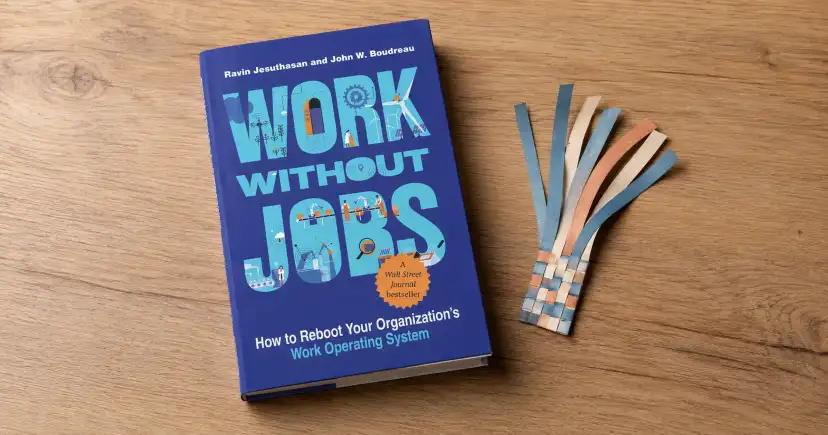
Work without Jobs and the missing link between skills and work
Work without Jobs proposes looking beyond the job as a whole and brings into view a layer that skill architectures often overlook: the work that needs to be organized.

From a skills gap to a capability gap: individual development is not always what is missing
Before recommending training in response to a gap, compare four possible sources: individual proficiency, team coverage, interfaces, and the operating model.

Leadership is not always management: how to represent cross-functional contribution
Some people change decisions, raise standards, and expand others' capability without managing a team. The architecture needs to represent that contribution without inventing informal authority.