
Not every critical skill is strategic: importance, scarcity, and advantage are not the same
Although importance, scarcity, and advantage are often compressed into the label “critical skill,” each dimension requires different evidence and investment. Separating them changes what must be protected, sourced, or built as a system.
The catalog marks 30 skills as strategic. Some sustain basic obligations, others are difficult to hire for, and a third group appears in the strategy presentation. The shared label avoids deciding why each one matters.
Importance asks what happens when it is missing
A skill is important when its absence interrupts a material outcome, increases risk, or prevents the organization from meeting an obligation.
It may be abundant in the market and provide no differentiation. The priority is to ensure coverage, standards, and recovery.
ISO 22301 establishes requirements for organizational continuity and resilience systems. It does not classify skills, but it poses the question of exposure: what must be sustained during a disruption, and how should recovery be prepared? ISO 22301:2019 (opens in a new tab).
Treating a foundational capability as less strategic does not justify neglecting it. It may produce no advantage and still be essential to operations.
Scarcity asks what it costs to gain access
A capability is scarce when supply is limited, development takes time, or demand for it is intense.
The response focuses on sourcing: build, hire, move, partner, or automate. It also considers dependency and time. A scarce skill may be peripheral to strategy and require only a limited solution.
Scarcity changes. A new tool can expand supply; regulation can create demand; an available person can remain inaccessible because their unit cannot release them.
Measuring only the external market hides those internal constraints.
Distinguish absolute scarcity from accessible scarcity. The organization may have people with the skill and still have no one available for the priority because incentives, permissions, or workloads keep them immobile. The diagnosis changes: training or hiring may not be necessary; assignment needs to be redesigned and capability released.
Advantage asks which configuration enables differentiation
Barney links sustainable advantage to resources that are valuable, rare, and difficult to imitate or substitute. His analysis concerns firm resources, not a direct taxonomy of skills. Jay Barney, Firm Resources and Sustained Competitive Advantage, 1991 (opens in a new tab).

The useful application requires looking at configurations. A single skill rarely explains a difference. What matters is how it combines with data, processes, relationships, decisions, and the operating model: a collection of skills does not create organizational capability on its own.
To test the relationship with advantage, describe the mechanism. Does the configuration improve a decision, cut a time that is difficult to match, enable earlier learning, or tailor an offering with greater precision? Then look for plausible alternatives. If any competitor can achieve the same outcome by buying a standard tool, the skill retains value without constituting a sustainable advantage.
A commercial practice may be important and common. A technical specialty may be scarce without affecting the value proposition. A particular way of integrating customer knowledge, design, and operations may differentiate even when its components are familiar.
The same skill can occupy several dimensions
A capability may be important and scarce. It may also participate in a differentiating configuration. Each relationship needs its own evidence.
For importance, observe disruption, obligation, and recovery time. For scarcity, review supply, lead time, and access alternatives. For advantage, explain which decision, cost, speed, or adaptation changes because of the configuration.
Avoid adding the dimensions into a score that hides them again. Two skills with the same total result may require opposite responses: protecting coverage in one case and building a hard-to-reproduce combination in the other.
A decision record can keep the three columns and add evidence, time horizon, owner, and action. “Important” requires a continuity condition; “scarce,” a hypothesis about access; “advantage,” a mechanism of differentiation. If there is insufficient evidence, mark the uncertainty. Classifying by executive intuition and then treating the label as data only displaces judgment without making it visible.
Classification must lead to a decision
A matrix without consequences creates more precise labels while preserving the same discussion.
Importance guides continuity, backup, and standards. Scarcity guides sourcing, retention, and dependency. Advantage guides selective investment, integration, and learning that is difficult to copy.
The decision also needs a time horizon. A capability that is strategic today may lose relevance if the value proposition changes. An abundant skill can become critical when exposure increases or authority becomes concentrated.
Investment should follow the dimension. Standardize and back up what is important; diversify sources and reduce dependency where there is scarcity; protect integration and learning where differentiation exists. Applying premium retention, academies, and maximum controls to everything labeled “critical” dilutes resources and makes priorities impossible to explain.
Strategy chooses which configurations allow the organization to operate, respond, or compete in a particular way. One limit remains that no label can resolve: evidence of advantage may change before the taxonomy does, so the classification must always remain open to review.
To extend this reading, see From a skills gap to a capability gap: individual development is not always what is missing and A strategy without available capabilities is only an aspiration, which develop complementary dimensions of the problem.
Keep exploring

Generalists, specialists, and hybrid roles: what the architecture should decide
Does the organization need breadth, depth, or integration? Generalist, specialist, and hybrid are possible answers, not identities the architecture should fix permanently.

Build, hire, move, partner, or automate: five responses to a capability gap
To choose among building, hiring, moving, partnering, or automating, compare the demand, the time horizon, and the dependencies each response creates.
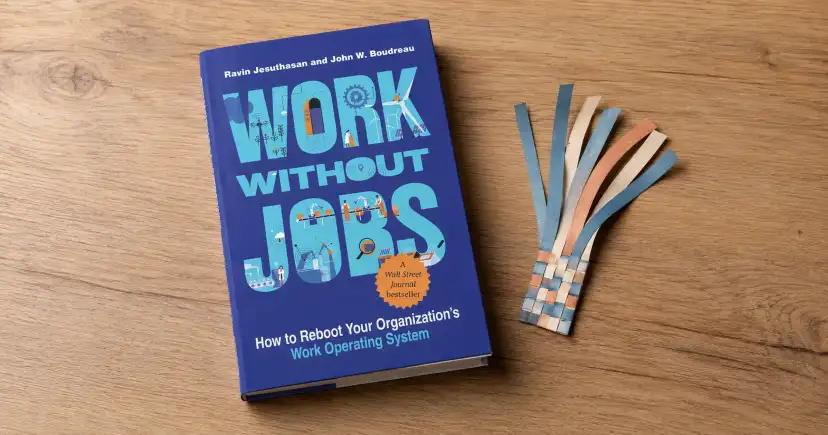
Work without Jobs and the missing link between skills and work
Work without Jobs proposes looking beyond the job as a whole and brings into view a layer that skill architectures often overlook: the work that needs to be organized.

From a skills gap to a capability gap: individual development is not always what is missing
Before recommending training in response to a gap, compare four possible sources: individual proficiency, team coverage, interfaces, and the operating model.

From headcount to capability: what should change in workforce planning
Staffing decisions require knowing how many people there will be. Capability planning also requires understanding what work they can sustain, under which constraints, and with what coverage.

Leadership is not always management: how to represent cross-functional contribution
Some people change decisions, raise standards, and expand others' capability without managing a team. The architecture needs to represent that contribution without inventing informal authority.