
From a skills gap to a capability gap: individual development is not always what is missing
Before recommending training in response to a gap, compare four possible sources: individual proficiency, team coverage, interfaces, and the operating model.
Why does an operation that handles complex refunds frequently miss its promised deadline? The dashboard shows stalled cases, and interviews reveal uncertainty about how to resolve exceptions. The conclusion seems obvious: technical judgment needs to be developed.
The situation is hypothetical. It illustrates why an inadequate result can admit competing explanations.
When several cases are reconstructed, another pattern emerges. People understand the rules for their part of the process, but an exception must pass through three areas. Each reviews different information, no one retains the full picture, and final authorization depends on a weekly meeting. A course may improve knowledge while leaving the bottleneck intact.
The mistake is not in observing a gap. It is in deciding too early where that gap resides.
A gap names a distance, not its cause
Comparing current and required performance can establish that there is a difference. That comparison does not show whether the right response is to train, hire, redistribute, automate, or change a rule.
Even the term “skills gap” can combine different problems. In its review of financial workforce planning at the U.S. Department of Defense, GAO distinguishes between an insufficient number of people and insufficient competencies. The institutional scope is specific, but the distinction prevents us from treating quantity and proficiency as if they were the same. GAO, DOD Financial Management: Action Needed to Enhance Workforce Planning (opens in a new tab).
For an organizational decision, the diagnosis should be expanded even further. Capability depends on the necessary contributions being available, connected, and authorized when the work requires them.
Four competing hypotheses
The first is an individual gap. A person faces a representative task and cannot interpret the information, choose a method, or perform at the expected level despite having reasonable conditions. Development, supported practice, or the addition of expertise may be appropriate here.
The second is a configuration gap. The knowledge exists, but it is concentrated, poorly distributed, or mismatched with the moments of demand. A team may have an excellent specialist and still be fragile if every exception depends on her availability.
The third is an interface gap. Each area fulfills its part, but the handoff loses context, duplicates controls, or leaves a decision without an owner. The problem arises between contributions, not within a person.
The fourth is an operating model gap. The rules, priorities, or authorizations make it impossible to respond as expected. The system may demand speed while also requiring everyone to wait for a body that meets once every seven days.
The evidence changes with the hypothesis
To test an individual gap, observe a representative task and the decisions the person makes. Do not rely solely on self-perception or course attendance.
To examine configuration, trace demand, coverage, overlap, and dependencies. Ask what happens during absences, peaks, or concurrent incidents.
To review interfaces, follow one case from end to end. Record which information enters and leaves, who decides, how long the work waits, and where a check is repeated.

To assess the operating model, compare objectives with rules, authority, technology, and incentives. If a policy requires routine decisions to be escalated, the apparent deficit may be a consequence of the design.
CIPD defines workforce planning as balancing the supply of labor and skills, future demand, and actions to close the difference. That perspective helps avoid an exclusively training-based interpretation: the intervention belongs to a portfolio of responses, not a single mechanism. CIPD, Workforce planning (opens in a new tab).
Returning to the case changes the intervention
In the refund operation, the review identifies two real needs. Some people need more practice interpreting uncommon exceptions. At the same time, the longest delay occurs because the three areas use incompatible priority criteria and the final decision cannot be made during daily operations.
The response combines several actions: practice cases, shared criteria, complete transfer of information, and defined authority to resolve certain cases without waiting for the weekly meeting.
No measure in isolation explains the entire result. Improvement depends on recognizing the level at which each one acts.
This reading continues Team capability is not the average of its members and From headcount to capability: what should change in workforce planning. The individual inventory and the number of people still provide information, but neither represents on its own the configuration that turns resources into a response.
Before launching a development program, the organization should be able to answer one simple question. What evidence demonstrates that the obstacle lies in individual proficiency rather than in the way the work is organized? If it cannot answer, it still has a gap to explain.
To extend this reading, see Developing a skill does not always increase organizational capability, which develops a complementary dimension of the problem.
Keep exploring

Generalists, specialists, and hybrid roles: what the architecture should decide
Does the organization need breadth, depth, or integration? Generalist, specialist, and hybrid are possible answers, not identities the architecture should fix permanently.
Not every critical skill is strategic: importance, scarcity, and advantage are not the same
Although importance, scarcity, and advantage are often compressed into the label “critical skill,” each dimension requires different evidence and investment. Separating them changes what must be protected, sourced, or built as a system.
Build, hire, move, partner, or automate: five responses to a capability gap
To choose among building, hiring, moving, partnering, or automating, compare the demand, the time horizon, and the dependencies each response creates.
Work without Jobs and the missing link between skills and work
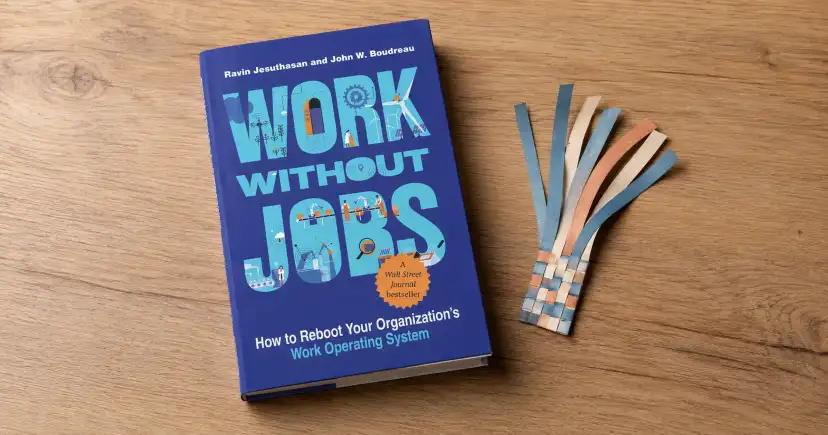
Work without Jobs proposes looking beyond the job as a whole and brings into view a layer that skill architectures often overlook: the work that needs to be organized.
From headcount to capability: what should change in workforce planning
Staffing decisions require knowing how many people there will be. Capability planning also requires understanding what work they can sustain, under which constraints, and with what coverage.
Leadership is not always management: how to represent cross-functional contribution
Some people change decisions, raise standards, and expand others' capability without managing a team. The architecture needs to represent that contribution without inventing informal authority.