
Generalists, specialists, and hybrid roles: what the architecture should decide
Does the organization need breadth, depth, or integration? Generalist, specialist, and hybrid are possible answers, not identities the architecture should fix permanently.
Compare configurations against the same demand
During a transformation, one person connects functions and dependencies. Another solves the most technically challenging problem. A third translates between two domains so the solution can work in practice.
Asking which profile is best makes little sense without understanding the work. The architecture should describe the combination of breadth, depth, integration, and accountability the situation requires.
Breadth means selecting and connecting
A generalist’s contribution is not a superficial knowledge of every subject. It emerges in recognizing relationships, integrating perspectives, and deciding when to draw on deeper expertise.
Expectations should make the scope, quality of synthesis, and judgment needed to coordinate specialties explicit. A long catalog of skills at low levels does not necessarily represent breadth. It may describe exposure without the ability to integrate.
The risk arises when the organization uses a generalist as a permanent substitute for capabilities that require mastery. Coordinating a decision and resolving its technical exception are different responsibilities.
Depth needs an operational boundary
A specialist addresses complexity, novelty, or consequences beyond everyday practice. Depth is visible in the quality of judgment, the range of problems addressed, and the ability to explain limits.
The architecture also needs to show how that knowledge reaches others. A specialty without interfaces can become a dependency. Define which decisions the specialist retains, which they delegate, and how to consult them without turning every situation into a wait.
Scarcity does not make every kind of depth strategic, either. Demand and its relationship to outcomes determine where it is worth maintaining that depth internally.
Integrating two domains should serve a purpose
A hybrid role combines specific elements because a decision, interface, or outcome crosses boundaries. It does not need to encompass two entire professions.
Creating a catalog for every blend destroys comparability. It is more useful to retain common components and make the specific expectations for integration, context, and autonomy visible.
The architecture represents reusable work
NIST defines the NICE Framework’s Work Roles as groupings of work, distinct from jobs or occupations. Its components connect roles, tasks, knowledge, and skills; the current version as of August 2026 is 2.2.0. The domain is cybersecurity, but it provides a concrete reference for describing work without relying on titles alone. NIST NICE Framework (opens in a new tab).
Within a track, roles share the same set of skills and differ in level, autonomy, complexity, scope, and impact. Across tracks, the architecture recognizes shared capabilities, new ones, and those that need adaptation.

This separation avoids turning each person into a taxonomy. It also allows configurations to change as demand changes.
One person can move through several configurations
Exploring a new need favors breadth. Resolving a critical exception requires depth. Bringing the solution to another unit calls for integration. All three contributions may appear at different points in a career.
The OECD argues that skills-first approaches need a common language and recognition of capabilities to connect learning and work. That framework does not prescribe generalist or hybrid profiles. It reinforces the need to describe contributions in a way that travels across titles and contexts. OECD, 2026 (opens in a new tab).
Development paths should indicate which experiences broaden, deepen, or integrate capability. Subsequent assessment requires evidence appropriate to the configuration, without concluding that someone permanently “is” one type.
Do not let the label govern assignments
Labeling someone a generalist can exclude them from deep problems they already know how to solve. Calling them a specialist can keep them out of integration decisions. A profile should summarize useful evidence, not define an immutable boundary.
To assign work, start with demand and build a configuration. List the decisions, interfaces, uncertainty, and consequences. Then identify which capabilities can sit with one person, which require collaboration, and where independent review would be valuable.
This analysis makes the cost of each design visible. Concentrating breadth and integration speeds up coordination but can create a single point of translation. Distributing depth improves coverage and requires more calibration mechanisms. A hybrid role reduces handoffs at an interface but may accumulate incompatible expectations.
Review the configuration when the volume, variety, or consequences of the work change. What worked as a hybrid combination at one stage may need two specialties and an integrating function at scale. Depth that remains singular should be reserved, while the rest can multiply capability. The architecture should allow that evolution without framing the change as a person’s failure.
Decide on the portfolio, not the ideal profile
The ultimate unit is the work system. Where does it need a broad perspective? Which problems require depth that is hard to replace? At which interfaces is value lost through a lack of translation? Who is accountable for bringing the whole together?
Test the portfolio against scenarios, not just average demand. Stable operations may be supported by distributed breadth and occasional access to specialists. An incident, an expansion, or a regulatory change may require depth on several fronts at once. The architecture should show which configuration serves everyday work, which responds to peaks, and which dependency is explicitly accepted.
A useful architecture distributes these functions, shows their dependencies, and allows the combination to change. Maintaining it requires recording signals and reviewing the configuration without opening a complete redesign for every new development. The aim is not to enshrine an ideal profile. Does the full demand have access to breadth, depth, and integration in the proportions it actually requires?
The configuration also needs to make visible the contribution that integrates decisions across functions without confusing influence with management. That distinction recognizes cross-functional leadership without creating a parallel hierarchy.
Keep exploring

Not every critical skill is strategic: importance, scarcity, and advantage are not the same
Although importance, scarcity, and advantage are often compressed into the label “critical skill,” each dimension requires different evidence and investment. Separating them changes what must be protected, sourced, or built as a system.

Build, hire, move, partner, or automate: five responses to a capability gap
To choose among building, hiring, moving, partnering, or automating, compare the demand, the time horizon, and the dependencies each response creates.
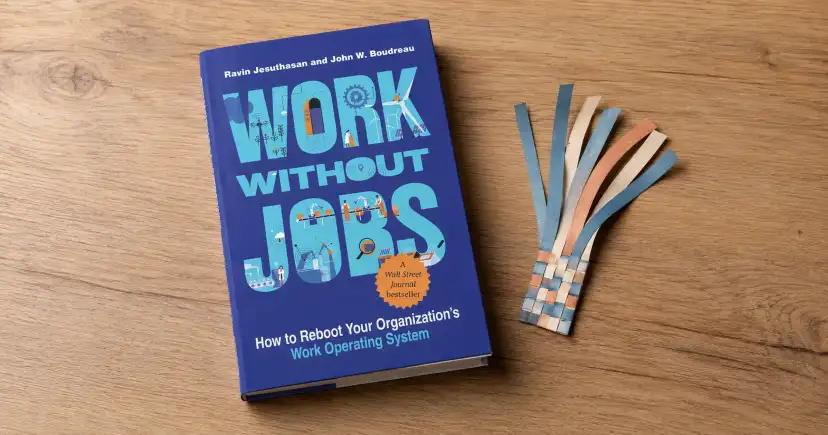
Work without Jobs and the missing link between skills and work
Work without Jobs proposes looking beyond the job as a whole and brings into view a layer that skill architectures often overlook: the work that needs to be organized.

From a skills gap to a capability gap: individual development is not always what is missing
Before recommending training in response to a gap, compare four possible sources: individual proficiency, team coverage, interfaces, and the operating model.

From headcount to capability: what should change in workforce planning
Staffing decisions require knowing how many people there will be. Capability planning also requires understanding what work they can sustain, under which constraints, and with what coverage.

Leadership is not always management: how to represent cross-functional contribution
Some people change decisions, raise standards, and expand others' capability without managing a team. The architecture needs to represent that contribution without inventing informal authority.