
Leadership is not always management: how to represent cross-functional contribution
Some people change decisions, raise standards, and expand others' capability without managing a team. The architecture needs to represent that contribution without inventing informal authority.
Although systems find it convenient to associate leadership with hierarchical position, that describes only part of the work. The title identifies who approves, allocates resources, or evaluates performance.
Outside that line, someone aligns a practice, brings perspectives together, safeguards a standard, or helps resolve a decision that crosses functions.
Recognizing that influence does not require calling every collaborative behavior leadership. It requires describing what changes because of it and where its mandate ends.
Separate authority, influence, and accountability
Management includes formal powers over people, priorities, and resources. Cross-functional influence works through knowledge, trust, evidence, relationships, or legitimacy granted by a community. The two can coincide, but they are not interchangeable.
An unclear architecture assigns accountability for a cross-functional outcome without clarifying which decisions the person can make. The role is left either persuading indefinitely or exercising authority that nobody formalized.
Represent separately the outcome the role must safeguard, the decisions it can lead, the matters it needs agreement on, and the cases it must escalate. That boundary protects the role and the people working with it.
Describe the scope of the contribution
“Influences others” says little. Specify whom, on which matters, and with what consequences. Someone may guide their immediate team, coordinate several functions, uphold a corporate standard, or represent the organization to external stakeholders.
Scope is not the same as the number of people reached. Defining a criterion used by hundreds can be a broad but routine contribution. Resolving a tension among three areas over an irreversible decision may involve greater complexity. Reach, uncertainty, and consequences therefore need to be considered together.
The evidence changes too. Counting meetings or followers is not enough for a cross-functional contribution. Look for better-integrated decisions, standards adopted with understanding, conflicts resolved without concealing disagreements, and capability that remains after the person steps away.
Recognize how legitimacy is earned
Without hierarchical authority, influence needs an understandable basis. It may come from demonstrated experience, an explicit mandate, responsibility for a risk, knowledge of the system, or trust built across areas. Naming that basis avoids confusing popularity with leadership.
Legitimacy is not permanent, either. An expert may lead a technical decision without a mandate to set commercial priorities. A community may recognize a trusted practitioner while the organization still gives that person no access to the forums where the standard is decided.
Do not turn influence into invisible work
Cross-functional tasks are often added on top of a primary role: mentoring, coordination, review, or representation. If time is not protected and output expectations are not adjusted, the organization receives leadership subsidized by the individual.
There is also a risk of unequal distribution. People who are trusted or sustain relationships are asked for more emotional and integrative work, even when that contribution does not appear in progression criteria. Recording the contribution helps, but is not enough: the organization must decide what the person stops doing and how the value generated is recognized.

A useful review asks whether the influence expands autonomy or concentrates dependency. If every decision returns to the same trusted person, the cross-functional role may be creating another bottleneck.
The evidence on shared leadership has useful limits
A meta-analysis by Wang, Waldman, and Zhang found a positive relationship between shared leadership and effectiveness across 42 independent samples. The relationship was stronger in complex work. The concept examines distributed influence within teams; it does not, by itself, validate a role architecture or establish causality for every organization. It does reinforce the value of observing who actually participates in the leadership function, alongside who holds the management position. Wang, Waldman, and Zhang, 2014 (opens in a new tab).
Pearce and Conger brought together perspectives on shared leadership as a process of influence among members. That view makes it possible to recognize that direction can shift with the task without removing formal accountability. Pearce and Conger, 2003 (opens in a new tab).
Distinguish cross-functional contribution from constant availability
Recognizing a cross-functional role can turn a person into the universal destination for questions. That outcome does not demonstrate greater leadership. It may indicate that interfaces still lack clear criteria and the rest of the organization has delegated coordination to a trusted figure.
Define which situations require the person’s involvement and which should be resolved using agreed standards. Observe whether areas learn to integrate perspectives themselves or always wait for the same mediator. The contribution multiplies capability when it leaves behind reproducible decisions, not when it accumulates a presence in every conversation.
Also review the conflicts the role should not absorb. A tension between priorities needs executive authority; a technical disagreement may need expert evidence; a coordination failure may require process redesign. Calling every repair leadership obscures who should answer for the cause.
Design progression without creating a parallel hierarchy
A cross-functional path can advance through the complexity of problems, the breadth of connected systems, the quality of judgment, and the ability to multiply responses. It does not need to copy the levels of a management track or promise automatic equivalence in status.
At each stage, specify which decisions the contribution changes and which conditions enable it. Someone may begin by facilitating agreements within a practice, then integrate standards across areas, and ultimately guide high-impact decisions. Progress lies in the nature of the contribution, not in accumulating leadership labels.
The organization needs to preserve one final distinction. Recognizing influence does not release those with formal authority from accountability for the consequences. Cross-functional contribution improves the decision; governance must still show who makes it, who can challenge it, and who is accountable for its outcome.
When leadership and management cease to be synonyms, the architecture can better describe how work moves. It can also avoid the opposite mistake: asking someone to lead without giving them the mandate, capability, or recognition to do so.
It also reveals a broader design condition: a cross-functional contribution cannot release capability if the operating model retains the decisions, data, or interfaces that constrain it. The architecture needs to show that constraint before assigning the problem to the individual.
Keep exploring

When an expert should stop solving and start multiplying capability
Before asking an expert for more solutions, consider whether their next contribution should increase the system's autonomy. Multiplying capability changes the object of their work.

Generalists, specialists, and hybrid roles: what the architecture should decide
Does the organization need breadth, depth, or integration? Generalist, specialist, and hybrid are possible answers, not identities the architecture should fix permanently.

Not every critical skill is strategic: importance, scarcity, and advantage are not the same
Although importance, scarcity, and advantage are often compressed into the label “critical skill,” each dimension requires different evidence and investment. Separating them changes what must be protected, sourced, or built as a system.

Build, hire, move, partner, or automate: five responses to a capability gap
To choose among building, hiring, moving, partnering, or automating, compare the demand, the time horizon, and the dependencies each response creates.

Why leaders hold on to talent the organization needs to move
Why would a leader hold on to someone who could contribute more in another unit?
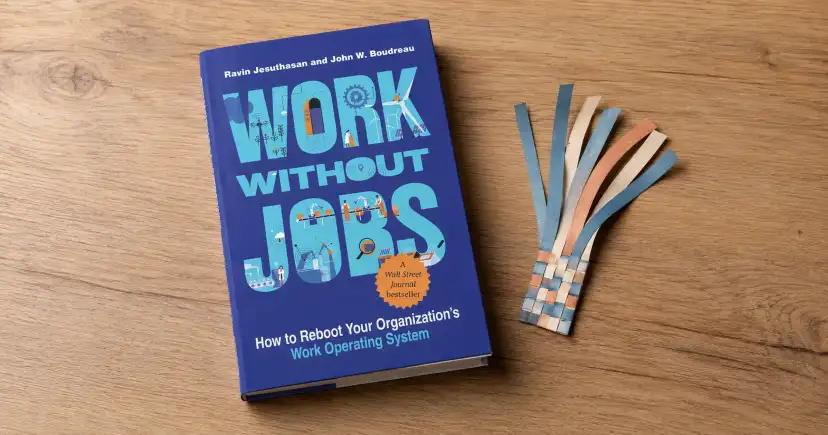
Work without Jobs and the missing link between skills and work
Work without Jobs proposes looking beyond the job as a whole and brings into view a layer that skill architectures often overlook: the work that needs to be organized.