
Build, hire, move, partner, or automate: five responses to a capability gap
To choose among building, hiring, moving, partnering, or automating, compare the demand, the time horizon, and the dependencies each response creates.
Why does a gap so quickly become a job opening? In one recent request, the ask seemed simple: bring in three specialists. The team had identified insufficient capability before examining the work.
When the demand was reconstructed, one part proved recurring, another exceptional, and a third consisted of preparing data manually. There was no longer a single gap or an obvious response.
Characterize the demand before choosing
Define the missing outcome, its frequency, the deadline, and the consequence of waiting. Distinguish a missing skill from insufficient capacity, misplaced authority, a concentrated dependency, or a task that no longer makes sense.
CIPD describes workforce planning as balancing the supply and demand of labor and capabilities. Its guidance includes development, hiring, and outsourcing among the possible responses, as part of planning linked to the organization’s objectives. CIPD, Workforce planning, 2025 (opens in a new tab).
Demand also needs a time horizon. An urgent need that will last eight weeks does not justify the same structure as a core capability required for five years. Confusing the two leads to hiring for a temporary spike or outsourcing knowledge the organization will need to retain.
Add two questions that are often absent from the initial request. Is the demand confined to one area, or will it arise across several units? Does the organization need to control the method, or only ensure the outcome? The first changes the scale; the second changes how much knowledge and authority can remain outside the organization. A low-cost solution for an isolated case can create an expensive dependency when the need spreads.
Build when there will be enough practice
Developing internal capability works when the need will recur, there is time to learn, and the work provides genuine opportunities to apply what has been learned.
The plan should explain who will practice, on which decisions, and with what support. Completing training does not close the gap until autonomy, quality, consistency, or complexity changes.
Building internally retains knowledge and expands future options. It also takes time and can fail if the person returns to a context that does not allow them to apply what they learned.
Hiring and moving address different timelines
Hiring adds expertise that is not available internally or cannot be developed within the required timeframe. Before opening a position, verify that the market offers that combination and that the operating model will allow the organization to use it.
Moving reuses capability that has already been demonstrated. It can be faster, but it transfers a cost to the originating area and requires distinguishing direct transfer from adaptation still needed. Mobility does not increase total capability if it leaves another priority uncovered.

Both responses require a designed entry. A new hire needs context and access; an internal mover needs the conditions to perform against a different demand. Their previous title resolves neither transition.
Partner when specialized expertise should not become permanent structure
A partnership, vendor, or external specialist provides access to scarce expertise for a limited period. It is useful when the demand is exceptional or when learning before committing to a permanent structure is preferable.
Partnering introduces dependencies around availability, continuity, confidentiality, and knowledge transfer. The agreement should specify the outcome the third party will deliver, the decisions the organization will retain, and the knowledge that will remain when the relationship ends.
Automate when the work itself can change
Automation can remove repeatable steps, extend reach, or support a decision that still requires human judgment. Replacing a skill is only one possibility and rarely describes the full change.
First separate rules, exceptions, and accountability. If exceptions are frequent or the consequences are sensitive, hiding judgment inside an interface does not eliminate the need for it. It merely makes the accountable party less visible.
Compare a portfolio, not five labels
Use the same criteria for every option: time to availability, total cost, control, reversibility, recurrence, dependency risk, and organizational learning.
ISO 30409 provides a scalable framework for workforce planning. It does not prescribe these five responses, but it supports starting from current and future needs before deciding how to meet them. ISO 30409:2016 (opens in a new tab).
The solution may be a sequence. A partnership addresses the urgent need, an internal move protects learning, and automation removes manual preparation. The resulting evidence can then inform whether to build or hire permanent capability.
To compare combinations, write a short profile for each alternative: the demand it covers, time to value, internal capability required, new dependency, and exit condition. That final condition matters. A temporary solution that never defines when it ends tends to become permanent by inertia; a permanent hire without recurring demand ends up searching for work to justify the cost.
State the assumption supporting the combination and a trigger for review. If recurrence, timing, or the cost of oversight changes, the right response changes as well.
A gap describes a distance. Before intervening, decide which part the organization should learn, which it needs to bring in, which it can redistribute, and which work it should stop doing.
To extend this reading, see From headcount to capability: what should change in workforce planning, Not every critical skill is strategic: importance, scarcity, and advantage are not the same, and Work without Jobs and the missing link between skills and work, which develop complementary dimensions of the problem.
Keep exploring

Generalists, specialists, and hybrid roles: what the architecture should decide
Does the organization need breadth, depth, or integration? Generalist, specialist, and hybrid are possible answers, not identities the architecture should fix permanently.

Not every critical skill is strategic: importance, scarcity, and advantage are not the same
Although importance, scarcity, and advantage are often compressed into the label “critical skill,” each dimension requires different evidence and investment. Separating them changes what must be protected, sourced, or built as a system.
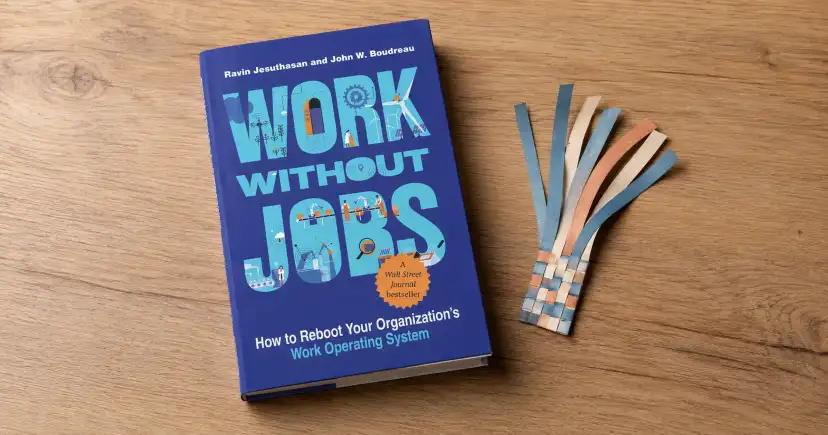
Work without Jobs and the missing link between skills and work
Work without Jobs proposes looking beyond the job as a whole and brings into view a layer that skill architectures often overlook: the work that needs to be organized.

From a skills gap to a capability gap: individual development is not always what is missing
Before recommending training in response to a gap, compare four possible sources: individual proficiency, team coverage, interfaces, and the operating model.

From headcount to capability: what should change in workforce planning
Staffing decisions require knowing how many people there will be. Capability planning also requires understanding what work they can sustain, under which constraints, and with what coverage.

Leadership is not always management: how to represent cross-functional contribution
Some people change decisions, raise standards, and expand others' capability without managing a team. The architecture needs to represent that contribution without inventing informal authority.