
Which skills can become obsolete even when the person remains competent
An uncomfortable finding about obsolescence is that a person can remain competent while the work loses the demand, context, or value that made their contribution useful.
What becomes obsolete: the person’s capability or its relationship with the work? Individual proficiency can deteriorate through lack of use, while work can also move beyond a capability someone still possesses. Cedefop includes both phenomena in its definition: skills can become less useful as work changes or atrophy through disuse. Distinguishing the two avoids prescribing training when the real problem is demand. Cedefop (opens in a new tab).
The task can disappear
When an activity is automated, eliminated, or moved outside the organization, the capability to perform it may remain intact. Its expected value changes because there is no longer enough work that requires it.
We should not jump to conclusions. An infrequent task can be critical to recovering from a failure, checking a result, or responding to an exception. Demand must be assessed by frequency, consequence, and the availability of substitutes, not just hours spent.
If the knowledge is needed only in contingencies, it may need to be concentrated in a reserve of expertise, documented, or sustained through periodic practice. Keeping it as a universal requirement would add cost without increasing real capability.
The standard can shift
Another form of obsolescence occurs when the outcome is still needed but methods, regulation, or expected quality change. The person is proficient in an earlier version of the practice. Here there may indeed be a need to update their skills, even if some of the knowledge retains its value.
Before declaring that someone has “fallen behind,” identify exactly what changed. It may be a tool, a standard, the type of acceptable evidence, or the expected autonomy. That precision makes it possible to decide whether to learn an extension, replace a method, or rebuild a more fundamental capability.
The date of an assessment does not prove that it is still current, either. Older evidence can remain relevant in a stable practice; a recent sample can become outdated if the standard changed the following week.
The system can take over execution
A tool can perform the visible part of a skill and shift the human contribution toward framing the task, checking the result, or taking responsibility for it. Someone who retains the ability to perform it manually has not lost competence, but that execution no longer differentiates the role.
The architecture must determine how much underlying knowledge is still needed. Oversight does not always require replicating every step; sometimes it does, especially when errors are difficult to detect or recover from. The answer depends on risk, not a general preference for retaining or eliminating skills.
This change also alters the evidence. Speed of production is no longer a sufficient signal when the system does the producing. The quality of review, the handling of exceptions, and the ability to explain limits will carry more weight.
The context can leave the organization
A skill can remain in demand in the market and cease to be strategic within a company that has changed its operating model. Outsourcing an activity, closing a business line, or standardizing a process changes where the capability resides.
Do not call the person obsolete when the organization made that decision. Language matters because it influences mobility and development. Record the decline in internal demand and identify which components can transfer to other work.

The OECD warns that development systems need to respond to technological, demographic, and environmental transformations. Its analyses operate at the level of countries and markets; they do not determine which skill a company should retire. They help frame updating skills as a relationship between learning and changing demand, not the unlimited accumulation of credentials. OECD, Skills Outlook 2025 (opens in a new tab).
Consider demand, criticality, and transferability together
Frequency alone does not determine a skill’s future. A capability in low demand can protect a critical operation; another that is used extensively may be easy to acquire or replace. Planning for capability rather than headcount helps represent that distinction before it becomes a development decision. Examine separately how much work is expected, what happens if the capability is unavailable, and how much of the proficiency can transfer to other contributions.
Add a time dimension. Demand for a capability may fall during a migration and recover if the new system fails to stabilize. Another capability may seem current because legacy contracts or tools still coexist with what is replacing them. Define a horizon, scenarios, and signals of reversal rather than turning a projection into a certainty.
The conversation with the person needs to reflect these differences. “Your skill is no longer useful” is imprecise and destructive. It is more honest to explain that expected demand has declined, which knowledge remains useful, and which experiences connect with emerging work. That clarity allows a choice among updating, transferring, and transitioning.
A decision needs more than a trend
Before retiring a skill or stopping its development, gather evidence of current use and reasonable future demand. Examine the consequences of not having it and the capabilities that replace it. Distinguish a temporary decline from a structural change.
Also review who still needs the knowledge. It may cease to be universal and retain value within an expert group. It may move from an entry requirement to a backup capability. Or it may become historical knowledge useful for migrating systems, even if it no longer defines progression.
Usage data is subject to bias. A capability can appear irrelevant because one person quietly handles every case. An absence of requests can also mean the service has become inaccessible. Combine records with observation of the work and failure scenarios.
Protect the transition, not the category
Maintaining a skill indefinitely out of respect for those who master it does not protect their careers. Neither does retiring it overnight. A responsible response recognizes the value created, identifies transferable capabilities, and offers experiences that connect people with new demand.
The organization must separate the decision about the catalog from the decision about the person. An entity can be retired without erasing historical evidence or reducing a career to a deficit. Proficiency retains its meaning even when it no longer warrants the same future investment.
A skill becomes obsolete within a specific relationship among person, work, system, and time. Before intervening, one decisive question remains: which of those elements changed? The answer avoids training someone for work that is disappearing and discarding knowledge that still protects a critical decision.
Keep exploring
When to stop developing a skill and redesign the work
To choose between developing a skill and redesigning the work, first locate the demand. It may lie with the person, an avoidable task, an interface, or variability in the system.

Generalists, specialists, and hybrid roles: what the architecture should decide
Does the organization need breadth, depth, or integration? Generalist, specialist, and hybrid are possible answers, not identities the architecture should fix permanently.

A career is not a ladder: how to represent real mobility paths
How can a career be represented when progress may come through specialization, projects, lateral moves, cross-functional leadership, and returns?
Not every critical skill is strategic: importance, scarcity, and advantage are not the same
Although importance, scarcity, and advantage are often compressed into the label “critical skill,” each dimension requires different evidence and investment. Separating them changes what must be protected, sourced, or built as a system.
The Inside Gig: when mobility no longer depends on job openings
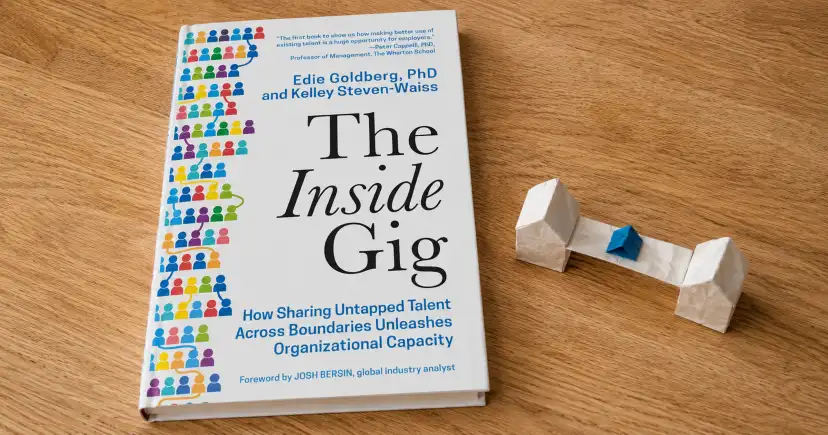
The Inside Gig proposes mobilizing talent through internal projects rather than waiting for a job opening, prompting an examination of what turns an opportunity into real work.

Build, hire, move, partner, or automate: five responses to a capability gap
To choose among building, hiring, moving, partnering, or automating, compare the demand, the time horizon, and the dependencies each response creates.