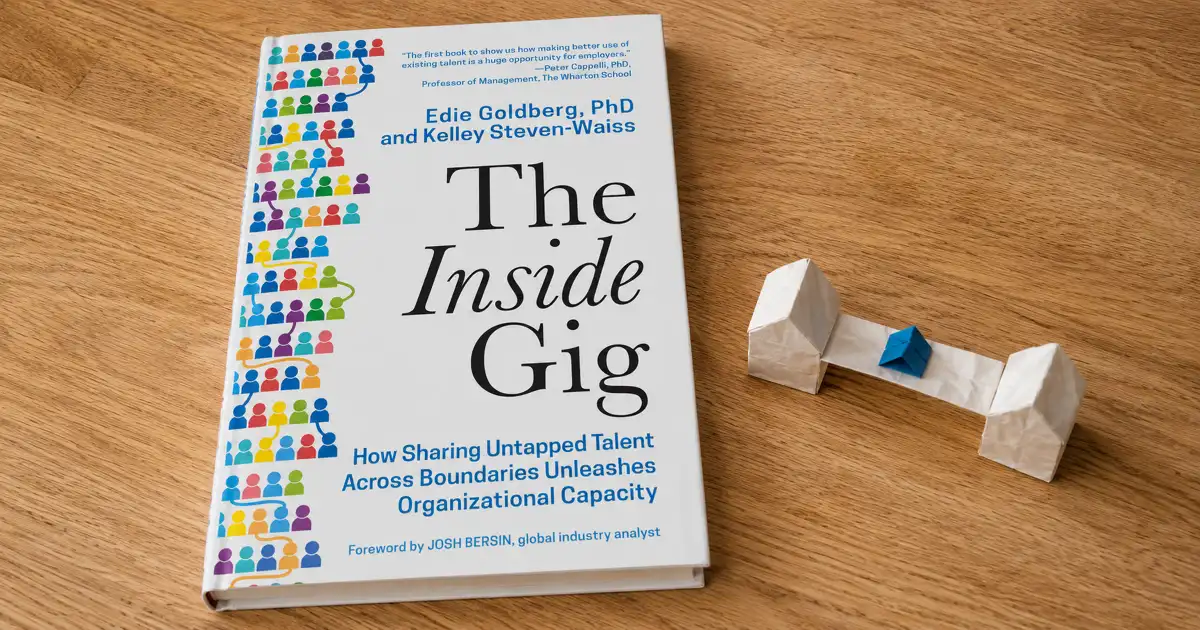
The Inside Gig: when mobility no longer depends on job openings
The Inside Gig proposes mobilizing talent through internal projects rather than waiting for a job opening, prompting an examination of what turns an opportunity into real work.
The book’s official presentation begins with a direct question: what if the capability the organization intends to hire for already exists inside it, associated with a different position or function?
Edie Goldberg and Kelley Steven-Waiss propose sharing talent across organizational boundaries. This reading draws on the book’s publicly available thesis and does not attribute chapters or cases that were not reviewed in the full text. Official website for The Inside Gig (opens in a new tab).
The proposal changes the unit of mobility. Gaining experience no longer requires leaving a current role or waiting for a promotion: lateral mobility can also be development. It can begin with a temporary contribution that exposes a person to a different demand.
The project must require a real contribution
An internal catalog can fill up with activities that have no priority, accountable owner, or consequence. Participation creates visibility, but not necessarily relevant experience.
A valuable gig has an expected outcome, a duration, constraints, and a contribution that someone needs. The person gains access to real decisions; the receiving team gains capability to move forward.
That precision makes transfer observable. An analyst can apply their judgment in another domain without claiming to have mastered the full role. The experience shows what transfers, what needs adaptation, and where support is required.
The project can also fail. A peripheral or overly protected contribution produces little evidence of autonomy. Its design must preserve a material difference from the person’s original work.
The platform does not create time
Publishing opportunities increases visibility. It does not resolve who releases the person from existing work or which priority wins when conflicts arise.
If the gig is added on top of the existing workload, mobility depends on informal time. People with greater autonomy or support can participate; those who sustain critical operations are excluded precisely because of their local value.
Participation rules need to cover the percentage of time committed, duration, backup in the originating area, and authority to resolve tensions. They must also recognize those who develop and release talent, because the cost appears before the organizational benefit.
Without these conditions, the internal marketplace reproduces defensive talent hoarding behind a more attractive interface.
Access can broaden opportunities or concentrate them
Internal projects reduce exclusive reliance on titles and formal career histories. They can also favor people who are already visible, know how to present themselves, or have leaders willing to recommend them.
The organization needs to observe who learns about opportunities, who applies, who is selected, and who drops out of the process. A high participation rate does not demonstrate equity if participants always come from the same areas.
The OECD presents skills-first approaches as a way to connect capabilities, learning, and work with less dependence on credentials. It also emphasizes the need for assessment, shared language, and institutional infrastructure. OECD, A Skills-First Labour Market, 2026 (opens in a new tab).
That framework broadens the reading of the book: democratizing opportunity requires more than discovering skills. It requires rules that turn them into contributions.
Completing a gig produces evidence, not an automatic credential
The closeout should record which decision the person took on, with what support, what outcome they produced, and which conditions limited the experience.
It is best to agree on these points before work begins. An opportunity brief can distinguish the project’s outcome, expected contributions, skills that might be observed, and what the gig cannot demonstrate. That separation protects the person from implicit promises and prevents the receiving team from turning an urgent need into an improvised assessment.
The evidence can support another assignment, a transition, or a development plan. It should not become a universal guarantee. The project may have involved less complexity, a narrow scope, or exceptional support.
The person also needs a useful interpretation. Being told that they “met expectations” says little about what they can reuse and what still needs to be observed.
Closing a gig can produce three different outcomes. The first is evidence about a specific contribution. The second is a new relationship between a person and a team that enables another opportunity. The third is a signal to redesign the internal marketplace: recurring demand may no longer belong in a gig and may require stable capability. Combining them under a single badge reduces what the experience can teach.
Mobility also distributes capability
The proposal becomes more powerful when it is no longer seen only as an individual benefit. Gigs allow scarce capabilities to reach temporary priorities, connect areas, and reveal demands the organizational chart does not represent.
That network introduces governance needs. The organization must address data access, priority conflicts, recognition, workload limits, and concentration of opportunity. Flexibility does not remove accountability; it changes where accountability must become visible.

Start with a limited set of projects and measure the system, not only satisfaction. Observe time to assignment, diversity of originating areas, the percentage of time actually protected, early terminations, and subsequent moves. Interpret each indicator in context: few applications may reflect low visibility, but they may also reveal poorly defined opportunities or a lack of permission to participate.
The Inside Gig opens up an alternative between staying in place and changing jobs. To test it, start where a short assignment would address a real demand and measure whether access, protected time, and evidence change who gets to contribute.
To extend this reading, see A career is not a ladder: how to represent real mobility paths, which develops a complementary dimension of the problem.
Keep exploring
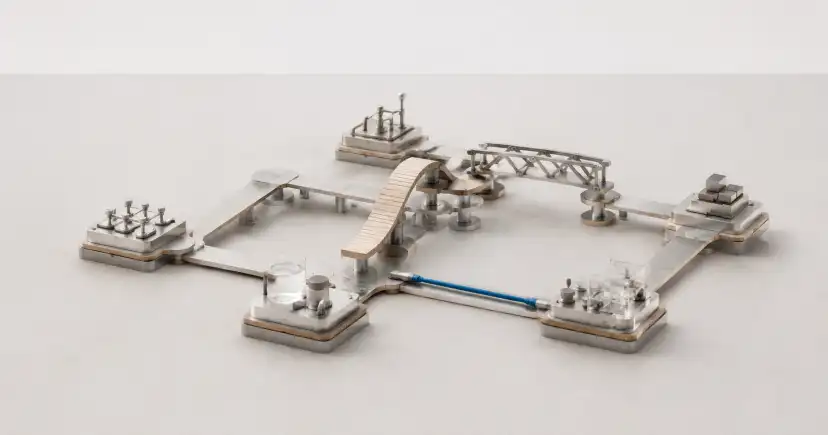
A career is not a ladder: how to represent real mobility paths
How can a career be represented when progress may come through specialization, projects, lateral moves, cross-functional leadership, and returns?
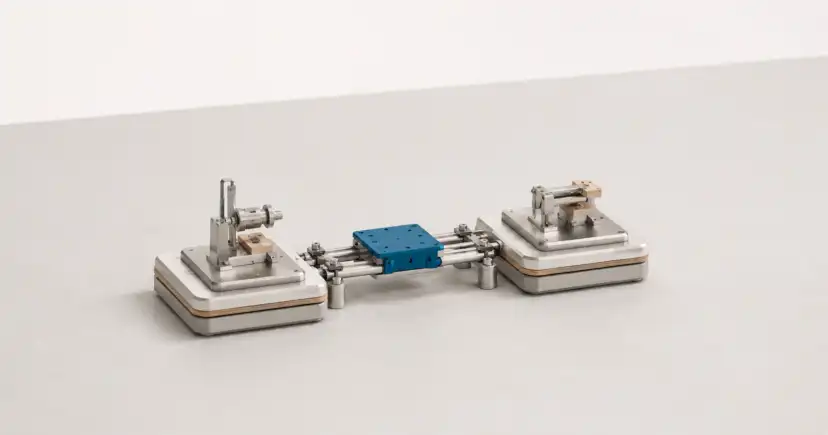
Lateral mobility can be development without being a promotion
Even without a change in hierarchy, lateral mobility can develop judgment by changing the problems, relationships, and decisions a person faces.
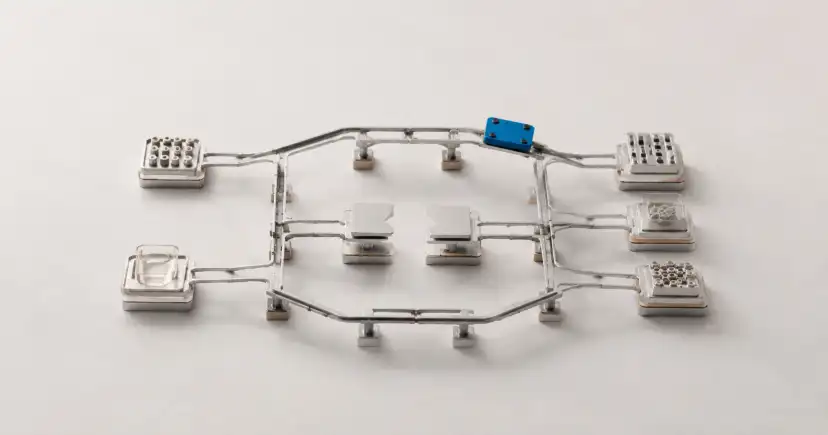
Succession without a bench: how to measure depth and coverage
A matrix showing two successors for every position can still hide severe dependency; coverage, depth, and time reveal how resilient the network really is.
What evidence an internal transition needs to stop being a gamble
Deciding on an internal transition requires four pieces of evidence. They must separate transferable capability, adaptation still needed, confirmed gaps, and entry conditions.

Why leaders hold on to talent the organization needs to move
Why would a leader hold on to someone who could contribute more in another unit?

Succession as an organizational capability, not a secret list
A list of possible replacements can create a sense of control while leaving intact the dependency that threatens the organization. Succession becomes a capability when the organization builds coverage, alternatives, and learning before a vacancy arises.