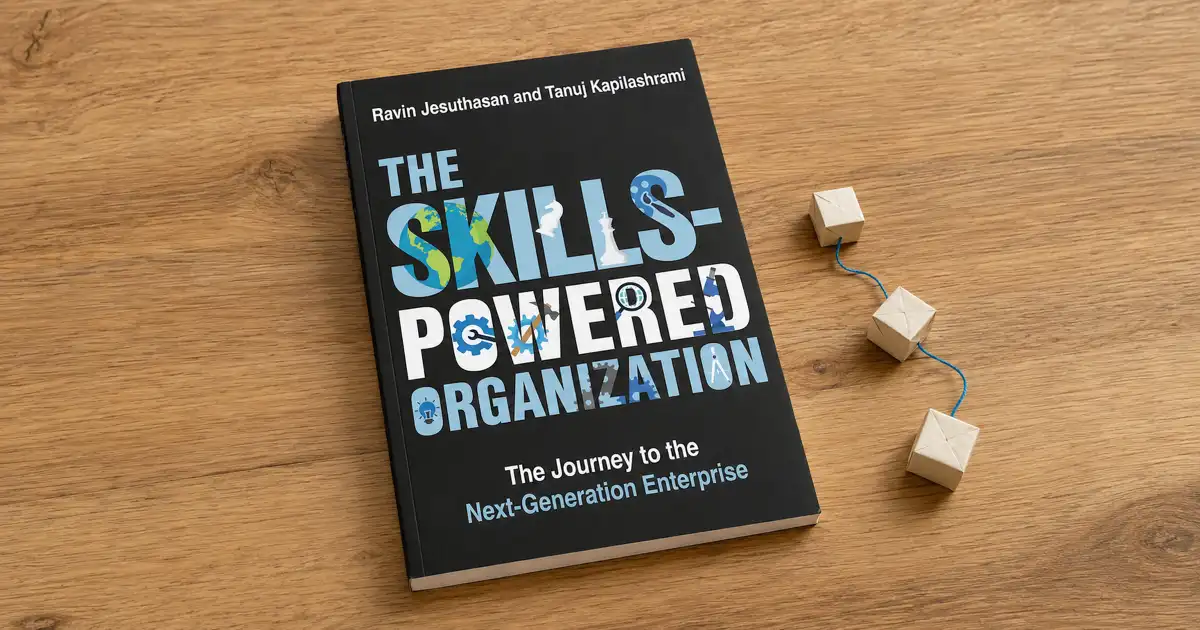
The Skills-Powered Organization and the shift toward capabilities
The Skills-Powered Organization proposes that skills should stop being auxiliary human resources data and become the unit through which a company designs work, allocates talent, and reinvents itself. Its most important contribution also defines its greatest demand: the change affects the organization's operating system.
Published by MIT Press in 2024, Ravin Jesuthasan and Tanuj Kapilashrami’s book builds on ideas Jesuthasan explored in Work Without Jobs. This time, the focus is on how to design and activate a skills-powered organization, drawing on business cases and a perspective that spans work, talent, leadership, and technology (MIT Press (opens in a new tab)).
This is not a book about building a better catalog. It is a proposal to change the basic unit of decision-making.
From the job as a container to skills as currency
The publicly available excerpt begins with a historical account. Industrial work grouped activities into jobs, jobs into families, and families into functions. This architecture made it possible to organize expectations, compensation, control, and careers around a relatively stable relationship between person and position. The authors argue that volatility, digital platforms, and artificial intelligence are decoupling work, time, place, and structure. In that context, skills begin to operate as a more precise currency for allocating capability (Jesuthasan and Kapilashrami, excerpt in Thinkers50 (opens in a new tab)).
The currency metaphor is powerful because it shifts the conversation. If the job is the unit, a new need is usually addressed by creating or filling a position. If the unit is the capability required for a piece of work, more options emerge: redistribute activities, develop someone, mobilize talent, combine internal and external contributions, or automate part of the work.
That is the source of the agility promised by the book. The organization can respond to changing demands with building blocks smaller than a complete job.
The book is most persuasive when it connects work and talent
Many skills-first initiatives begin with people: inventory what they know, infer profiles, or recommend learning. The Skills-Powered Organization turns to the other side of the exchange. Before matching can happen, the work must be understood and redesigned. Mercer’s presentation summarizes the journey as defining and assessing skills, rethinking talent management, redesigning work, and using AI-supported allocation (Mercer (opens in a new tab)).
That connection prevents a common mistake: accumulating skills data without clearly defined demand against which to interpret them. Knowing that someone is proficient in data analysis adds little if the organization has not defined what work requires that capability, at what depth, with what autonomy, and in what context.
It also makes mobility more concrete. A transition no longer depends only on previous job titles; it can examine reusable capabilities, the adaptation required, and new skills. The benefit does not come from eliminating roles, but from opening the container to see relationships hidden by the organizational chart.
The transition requires more architecture, not less
Skills-first language can sound like liberation from rigid structures. The risk is assuming that it is enough to break jobs into fragments and let a platform find matches. In reality, the smaller the units, the more important the rules connecting them become.
The organization needs an architecture that distinguishes skills, levels, roles, work, and evidence; data with a clear indication of how current they are; decisions about who maintains the language; and mechanisms that prevent a score from being used outside its purpose. The OECD has identified opportunities in skills-first approaches, but also risks involving bias, obsolescence, weakened protections, and the significant effort needed to build robust assessment, monitoring, and HR processes (OECD, 2025 (opens in a new tab)).

This limitation does not refute the book’s argument. It makes it more serious. Turning skills into currency requires institutions that define their value, rules for using them, and protection from unfair exchanges. Without that infrastructure, the promised precision can become an atomization of work or a new layer of labels.
Technology: accelerator and dependency
The authors include AI-powered allocation as a capability of a skills-powered organization. Technology can process combinations that a job structure does not reveal and match demand with supply at greater scale. But the quality of the result depends on how skills were defined, what evidence updates profiles, and which objectives govern the recommendation.
An algorithmic match does not, by itself, resolve the validity of the assessment or the fairness of the opportunity. Nor does it explain why someone does not appear in a search. The book opens a promising direction; applying it requires traceability, the ability to challenge outcomes, and human judgment in consequential decisions.
What the book leaves us with
Work Which activities and outcomes change.
Capability Which skills and levels sustain them.
The greatest value of The Skills-Powered Organization lies in taking skills beyond the boundaries of training. It connects them with work design, strategy, mobility, leadership, and resource allocation. It forces the question of what would genuinely change if the organization understood its capabilities better.
Its practical limitation is proportional to that ambition. The transition does not begin by purchasing a taxonomy or end by activating an internal marketplace. It requires redesigning decisions, data, responsibilities, and protections. For an organization expecting a lightweight implementation, the book should be read as a warning as well as an inspiration.
The proposal is most useful when it is not interpreted as the immediate replacement of every job. It works as a change in resolution: it makes it possible to look inside the role, recombine work, and build options that were previously invisible. The challenge is to gain that flexibility without losing context, coherence, or accountability.
Keep exploring

Generalists, specialists, and hybrid roles: what the architecture should decide
Does the organization need breadth, depth, or integration? Generalist, specialist, and hybrid are possible answers, not identities the architecture should fix permanently.

Not every critical skill is strategic: importance, scarcity, and advantage are not the same
Although importance, scarcity, and advantage are often compressed into the label “critical skill,” each dimension requires different evidence and investment. Separating them changes what must be protected, sourced, or built as a system.

What must remain common and what can vary across areas
Even when two areas work differently, they can still share an architecture. Adaptation stops being local when it changes meaning, comparability, or the rights attached to use.

Build, hire, move, partner, or automate: five responses to a capability gap
To choose among building, hiring, moving, partnering, or automating, compare the demand, the time horizon, and the dependencies each response creates.

When to split, merge, or retire a skill
Splitting, merging, and retiring a skill correct different failures. Even if the catalog looks tidier after the change, the choice depends on which distinction in the work must be preserved and which decisions will change.

Designing the interfaces between teams is also designing capability
On the eve of a launch, an incomplete interface can immobilize capability that each team does possess.