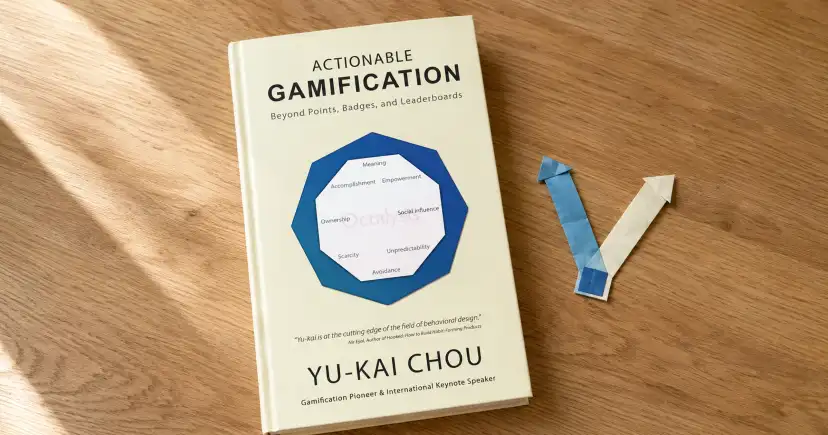
Actionable Gamification and the design of development
The most useful contribution of Actionable Gamification is not that it teaches us to turn learning into a game, but that it forces us to ask what sustains effort once novelty fades.
Articles about organizational intelligence, measurement, and human systems.
The most useful contribution of Actionable Gamification is not that it teaches us to turn learning into a game, but that it forces us to ask what sustains effort once novelty fades.

Being ready now does not mean being the best person on a list or eliminating every risk. It means that enough evidence exists to support a specific transition under known conditions.

A perception does not capture reality like a camera. It does, however, record how someone interprets what they could observe within a particular relationship, at a particular moment, and against specific expectations. That limitation does not make perception irrelevant; it determines how perception should be read.

Development rarely advances through clean jumps from one level to the next. Between levels, small changes in application, autonomy, consistency, or complexity deserve recognition without being converted into percentages of mastery.

Current performance, potential, and readiness answer different questions. Keeping them separate prevents strong performance today from becoming a promise about the future, or a possibility for growth from becoming a premature promotion.

Pulse, Check, Interview, and Target can coexist within the same assessment architecture, but they are not longer or shorter versions of the same instrument. Each mode answers a different question, produces a different kind of evidence, and supports conclusions with a distinct scope.

Reassessing too soon can mistake a recent activity for a developed capability. Reassessing too late leaves unanswered a question that could already be resolved. The right time depends not only on the calendar, but also on opportunities to practice, the quality of the evidence, and the stability of the change.

Changing roles does not erase capabilities that have already been demonstrated. Nor does it make them automatically transferable. A realistic transition distinguishes what can be reused, what requires adaptation, what is missing, and what has yet to be observed.

Missing evidence, conflicting evidence, and uncertainty are not the same problem. When they are collapsed into a generic category, an organization may manufacture certainty, defer a decision indefinitely, or treat something it has not yet observed as a gap.

An assessment that returns only a score provides less information than it used to reach its conclusion. The person needs to understand the result, the evidence behind it, its limitations, and what they can do with it.

A person may seem close to a role because many of their skills overlap, yet still face a difficult transition because of differences in level, context, autonomy, or experience. A job title may also make someone appear farther away than they are, obscuring a broader base of transferable skills than the organization recognizes.

An average can accurately represent the center of several results while concealing the difference that matters most to the decision. Its usefulness depends on which components it combines and which of them may compensate for one another.