How to distinguish current performance, potential, and readiness
Current performance, potential, and readiness answer different questions. Keeping them separate prevents strong performance today from becoming a promise about the future, or a possibility for growth from becoming a premature promotion.
Confusion often arises because all three concepts appear in the same talent conversation. A person delivers strong results, learns quickly, and is considered for a more complex role. It is tempting to compress everything into a single conclusion: they are ready. Yet each statement requires its own reference point, evidence, and time horizon.
Start with the decision
Before classifying someone, clarify the decision at hand. Recognizing a person’s contribution, designing a development experience, and filling an upcoming vacancy are not the same decision. The question determines which evidence matters.
| Concept | Question it answers | Primary reference |
|---|---|---|
| Current performance | How well is the person meeting the expectations of their current role? | Work completed, results and behaviors in the current context |
| Potential | What capacity for growth is reasonable to explore? | Learning, adaptation and the possibility of assuming greater complexity |
| Readiness | How close is the person to performing a specific role under defined conditions? | Requirements of the target role, available evidence and transition gaps |
Current performance: what happened under known expectations
Performance is assessed against current responsibilities and conditions. It includes results, quality, consistency, decisions, collaboration, and other indicators relevant to the work. The CIPD’s evidence review of people performance shows that the concept has several components and that measuring it requires deciding which dimension matters for the intended use (CIPD, 2022 (opens in a new tab)).
Useful questions are specific:
- What was expected of this role during the observed period?
- What results and behaviors can be reconstructed with evidence?
- Under what conditions was that performance produced?
- Is the pattern consistent or does it depend on an exceptional episode?
Automatically linking performance to promotion ultimately devalues the person’s current contribution and makes upward movement the only visible form of progress.
Potential: a hypothesis that must have direction
Potential looks toward a future demand, but it is not a general property of the person. Saying that someone has high potential without stating potential for what leaves the claim nearly empty. A person may show the capability to broaden their technical scope, coordinate dependencies, or lead a team; each trajectory requires different learning.
Potential is therefore better framed as a context-specific hypothesis: the evidence warrants exploring whether this person can handle greater complexity of a particular kind. The hypothesis may draw on the speed and quality of learning, adaptation to new contexts, the capability to integrate information, or responses to progressively more demanding responsibilities. It also needs genuine opportunities to be tested.
Ambition, confidence when speaking, or proximity to decision-makers is not enough. Nor should someone be penalized for not yet having received a visible assignment. A judgment about potential becomes more defensible when it identifies a direction for growth and records both favorable signals and the evidence still missing.
Readiness: distance to a specific destination
Readiness is the most specific of the three conversations. It refers to one role, or a narrow set of roles, within a defined time horizon. A well-designed competency model helps by clarifying what the target position requires and making it possible to analyze how close the person is. SIOP explicitly connects this clarity with readiness assessment and the strength of succession coverage (SIOP, 2022 (opens in a new tab)).
Estimating readiness requires comparing:
- demonstrated capabilities with the required level;
- current autonomy and expected autonomy;
- complexity already handled with the complexity of the target role;
- relevant experience, including situations not yet experienced;
- entry conditions, available support, and transition time.
Readiness is not permanent. It can increase through an assignment, become outdated if the role changes, or depend on availability and context. The CIPD describes succession as a process for identifying and developing talent for critical positions, with practical experiences connected to future roles. That places readiness within a journey rather than treating it as a permanent seal (CIPD, 2025 (opens in a new tab)).

How to keep the conversation clear
A talent review can proceed in three passes. First, describe performance without anticipating a destination. Then, when the evidence supports it, formulate a growth hypothesis and identify the experience that would test it. Only then should readiness for a specific role be assessed.
The order matters. If the conversation starts with the vacancy, the entire record can easily be reinterpreted to justify a preferred candidate. If it starts with a potential label, subsequent evidence can become mere confirmation. Separating the questions makes clear what is known, what is inferred, and what still needs to be observed.
A responsible conclusion might recognize strong performance, identify potential to take on greater coordination, and, at the same time, note that evidence of leading through a highly ambiguous situation is still missing before the person can be considered ready for a particular role. All three statements can coexist.
This precision improves both the decision and the conversation with the person. It recognizes what they already contribute, opens a possibility for growth without promising it, and turns readiness into an observable journey. None of the three concepts needs to become an identity.
Keep exploring
A career is not a ladder: how to represent real mobility paths
How can a career be represented when progress may come through specialization, projects, lateral moves, cross-functional leadership, and returns?
Succession without a bench: how to measure depth and coverage
A matrix showing two successors for every position can still hide severe dependency; coverage, depth, and time reveal how resilient the network really is.
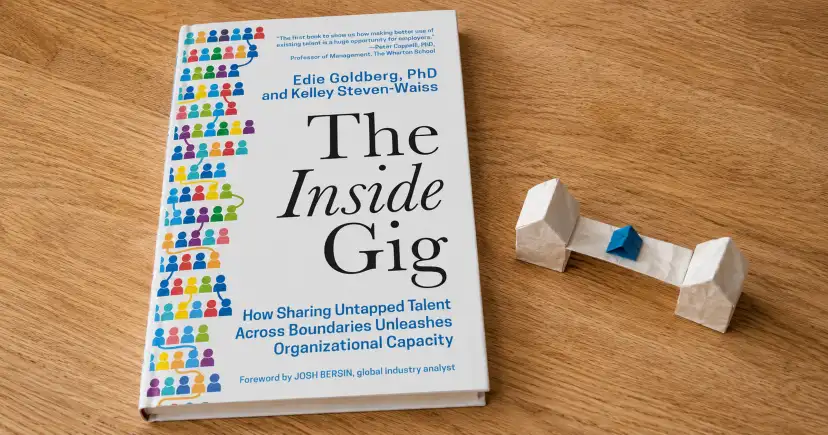
The Inside Gig: when mobility no longer depends on job openings
The Inside Gig proposes mobilizing talent through internal projects rather than waiting for a job opening, prompting an examination of what turns an opportunity into real work.
Why leaders hold on to talent the organization needs to move
Why would a leader hold on to someone who could contribute more in another unit?
Lateral mobility can be development without being a promotion
Even without a change in hierarchy, lateral mobility can develop judgment by changing the problems, relationships, and decisions a person faces.
Succession as an organizational capability, not a secret list
A list of possible replacements can create a sense of control while leaving intact the dependency that threatens the organization. Succession becomes a capability when the organization builds coverage, alternatives, and learning before a vacancy arises.