
What it means to be ready now for a critical role
Being ready now does not mean being the best person on a list or eliminating every risk. It means that enough evidence exists to support a specific transition under known conditions.
The expression is common in succession planning, but it often blends three questions: whether someone could grow into a role, whether they want to take it on, and whether they are prepared to do so today. Potential, availability, and readiness are not interchangeable.
The CIPD guidance on succession planning (opens in a new tab) begins by identifying critical roles and recognizes that succession planning can focus on individual positions or on talent pools that share skills. This places readiness in relation to a specific organizational need, not within a general ranking of talent.
Readiness always belongs to a role and a context
No one is ready now in the abstract. A person is ready to perform a defined role with a particular scope, team, time horizon, level of authority, and degree of exposure. The same person may be prepared for a transition within a stable unit yet need more experience to make that transition during a major transformation.
Without that reference, the assessment ends up rewarding similarity to the current role holder or visibility within the organization.
Five conditions to support the conclusion
1. Evidence of critical capabilities
Not every skill in the role carries the same weight in an immediate transition. Some can be developed during the transition; others are minimum entry conditions because the cost of learning them on the job would be too high.
The conclusion requires evidence of those critical capabilities through relevant behaviors, decisions, results, or explanations. Reputation and years of experience can help identify where to look, but they cannot replace evidence.
2. Performance under comparable complexity
Performing a smaller-scale task well does not automatically demonstrate readiness for a role with greater ambiguity, more dependencies, or more significant consequences. The most informative evidence comes from situations that approximate the future complexity: cross-functional projects, decisions made with incomplete information, coordination among stakeholders, or responsibility for broader results.
The person does not need to have held the same position before.
3. Known and manageable entry gaps
Being ready now does not require perfect mastery. It requires identifying the remaining gaps, ensuring they do not undermine critical entry conditions, and establishing a realistic pathway for addressing them.
An unknown gap is a risk that is difficult to manage.
It must also be distinguished from missing evidence: a capability that has not yet been observed cannot be assumed to be absent.
4. Available transition conditions
Readiness does not reside in the person alone. It may depend on knowledge transfer, temporary support, team composition, effective authority, access to key relationships, or the continued presence of certain experts.
A responsible conclusion makes those dependencies explicit. If the person would be ready only with a three-month overlap, and that overlap will not be available, the condition changes what ready now means.
5. Confirmed availability
A person may be prepared but not want the role, may be unable to take it on within the required time frame, or may prefer another career path. Allowing a manager to infer availability turns succession planning into a one-sided expectation.
The conversation should confirm interest, timing, and constraints without promising an appointment. Keeping this information separate protects both the organizational decision and the person’s autonomy.

A time-bound category, not a permanent label
Ready now describes a conclusion that can be reviewed. It may change if the role changes, new evidence emerges, transition conditions shift, or the person is no longer available. More than one person may also be prepared, each with different strengths and risks.
Succession planning improves when it abandons the idea of an absolute ranking and builds coverage instead. The goal is not to identify the best individual in secret, but to understand which options the organization has, under which conditions, and with what residual exposure.
The CIPD talent factsheet (opens in a new tab) describes talent pools as a way to prepare people for critical or future roles. This logic preserves alternatives and continuous development instead of creating a self-fulfilling prophecy around one person.
It should always be possible to complete the phrase ready now: for this role, in this context, with this evidence, under these conditions, and with these known risks. If the sentence cannot be completed, the organization probably has an impression rather than a defensible conclusion.
Keep exploring

A career is not a ladder: how to represent real mobility paths
How can a career be represented when progress may come through specialization, projects, lateral moves, cross-functional leadership, and returns?

Succession without a bench: how to measure depth and coverage
A matrix showing two successors for every position can still hide severe dependency; coverage, depth, and time reveal how resilient the network really is.
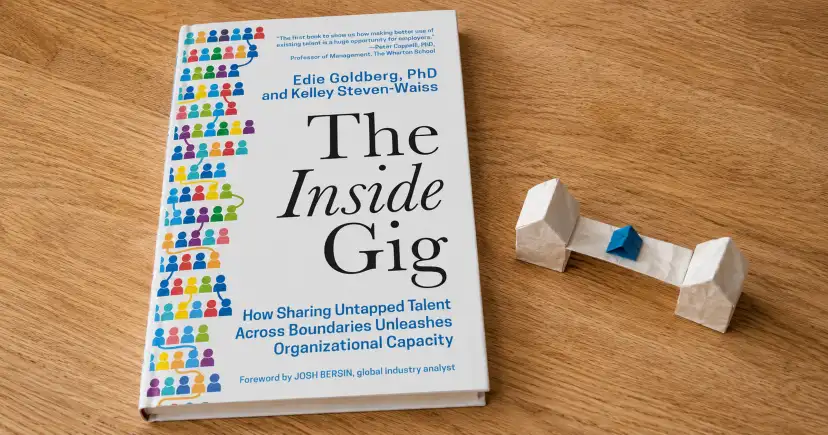
The Inside Gig: when mobility no longer depends on job openings
The Inside Gig proposes mobilizing talent through internal projects rather than waiting for a job opening, prompting an examination of what turns an opportunity into real work.

Why leaders hold on to talent the organization needs to move
Why would a leader hold on to someone who could contribute more in another unit?

Lateral mobility can be development without being a promotion
Even without a change in hierarchy, lateral mobility can develop judgment by changing the problems, relationships, and decisions a person faces.

Succession as an organizational capability, not a secret list
A list of possible replacements can create a sense of control while leaving intact the dependency that threatens the organization. Succession becomes a capability when the organization builds coverage, alternatives, and learning before a vacancy arises.