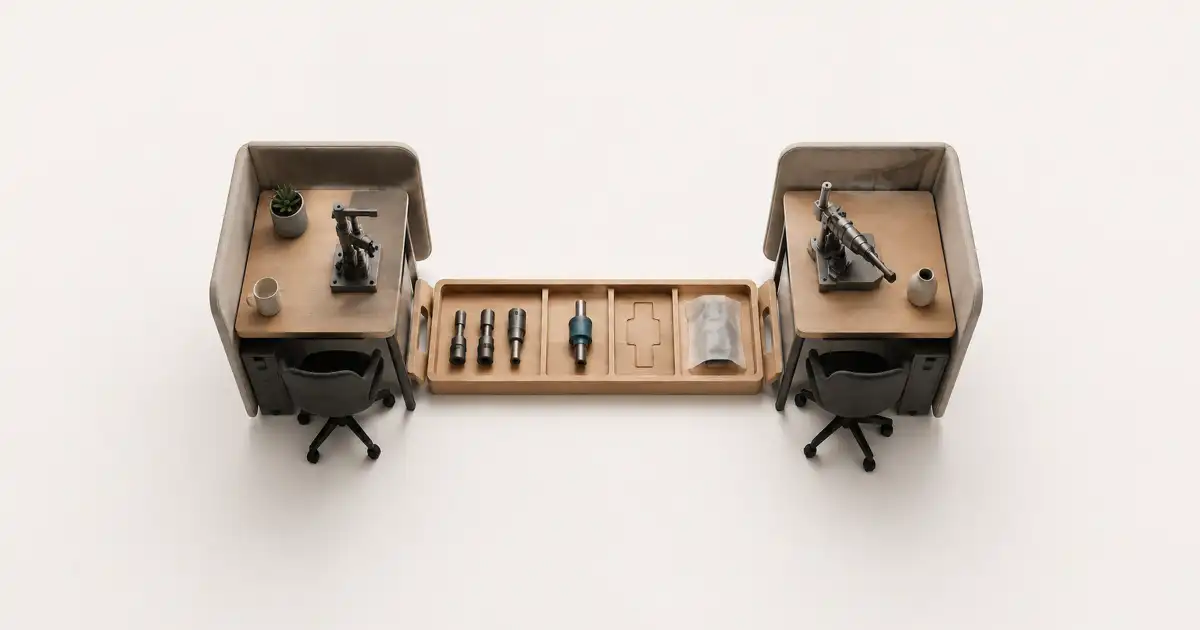
How to estimate the distance between two roles
A person may seem close to a role because many of their skills overlap, yet still face a difficult transition because of differences in level, context, autonomy, or experience. A job title may also make someone appear farther away than they are, obscuring a broader base of transferable skills than the organization recognizes.
Estimating that distance does more than produce a verdict about fit. It helps determine which capabilities can be reused, which require adaptation, which gaps have been confirmed, and what cannot yet be concluded because the evidence is insufficient.
1. Clarify what is being compared
Before considering a candidate, describe both roles using the same framework. If the source role is defined by tasks while the target role is described through broad attributes, any calculation will be misleading.
The comparison needs at least:
- the skills relevant to each role;
- expectations for level or range;
- the degree of autonomy and complexity;
- the scope of the decisions and their consequences;
- the contexts in which each capability must be applied;
- the evidence needed to recognize effective performance.
Job titles do not provide this level of precision. O*NET and ESCO show why occupational inventories can help: they organize skills that span different jobs and reveal relationships between transferable and role-specific capabilities. But an external catalog is a reference, not an automatic description of how a role operates within a particular organization.
2. Separate four types of distance
A single measure of overlap conceals differences that call for distinct responses.
Repertoire distance. The target role requires skills that are not part of the source role. This is the most visible difference, though not always the hardest to address. A new skill may be acquired quickly when it builds on related capabilities.
Level distance. The skill exists in both roles, but the expectation changes. Marking it as shared is not enough. The comparison must account for depth, autonomy, complexity, scope, and impact. Within the same track, this is often the primary source of distance.
Context distance. The person has demonstrated a capability but will need to apply it under different constraints, with different stakeholders, at a different pace, or with different consequences. Transfer does not mean replication. The question is how performance changes when the situation changes.
Evidence distance. The organization does not know whether the capability is present at the required level.
3. Analyze dependencies, not just elements
Two transitions with the same number of differences may vary greatly in difficulty. A missing skill may be peripheral, or it may enable several critical responsibilities.
For example, moving into a role that coordinates decisions across other areas may require autonomy the person has already demonstrated while adding knowledge of a specific domain. The transition may be manageable if that knowledge can be learned with support. By contrast, if the role demands sound judgment under ambiguity and that capability has not been observed, the distance remains uncertain even when nearly all the skills overlap.
Map the dependencies: which capability makes it possible to practice another, which experience can be gained only in context, and which difference would expose the person or the team to risk if underestimated.
4. Turn the comparison into a pathway
The useful output is not a 72% fit score. It is a transition proposal that distinguishes among several categories.
- Direct reuse: capabilities demonstrated under sufficiently similar conditions.
- Transfer with adaptation: existing capabilities that must be tested in a new context.
- Confirmed gap: sufficient evidence shows performance below the expectation.
- Insufficient evidence: the capability has not yet been observed in a relevant way.
- Entry condition: the authority, access, support, tool, or experience required to make the transition viable.
Each category leads to a different action. Reusable capabilities can be recognized from the outset. Adaptation requires practice in context. A gap may require development. Insufficient evidence calls for verification before intervention. An entry condition is part of designing the move, not a personal deficit.

5. Calibrate the decision to its reversibility
Not every move requires the same degree of certainty. A temporary assignment with support creates room to learn and produce evidence. A high-stakes promotion that is difficult to reverse and offers little support requires a higher threshold.
The estimated distance should be considered alongside the risk of the decision, how quickly it can be corrected, and the opportunities available for practice. This makes it possible to design progressive moves rather than wait for a perfect match that will probably never appear.
The final question is not how similar the two roles are. It is which parts of the journey have already been demonstrated, which can be adapted, and what conditions would make it possible to cover the remaining distance.
Keep exploring
Transferable skills — the organization's hidden capital
An organization may spend months searching for a capability that already exists within it but is associated with another title, another industry, or a problem described by a different name.
Leadership is not always management: how to represent cross-functional contribution
Some people change decisions, raise standards, and expand others' capability without managing a team. The architecture needs to represent that contribution without inventing informal authority.
How to maintain an architecture without turning it into a permanent project
Maintaining an architecture starts with distinguishing a signal worth recording, a small change with a clear owner, and a structural decision that deserves deliberate review.
Generalists, specialists, and hybrid roles: what the architecture should decide
Does the organization need breadth, depth, or integration? Generalist, specialist, and hybrid are possible answers, not identities the architecture should fix permanently.

Sorting Things Out: every taxonomy describes and decides
The book Sorting Things Out examines how categories and standards organize the world while distributing visibility, work, and consequences. Reading it through the lens of a skills architecture extends that inquiry to the decisions a taxonomy makes possible.
When an expert should stop solving and start multiplying capability
Before asking an expert for more solutions, consider whether their next contribution should increase the system's autonomy. Multiplying capability changes the object of their work.