Actionable Gamification and the design of development
The most useful contribution of Actionable Gamification is not that it teaches us to turn learning into a game, but that it forces us to ask what sustains effort once novelty fades.
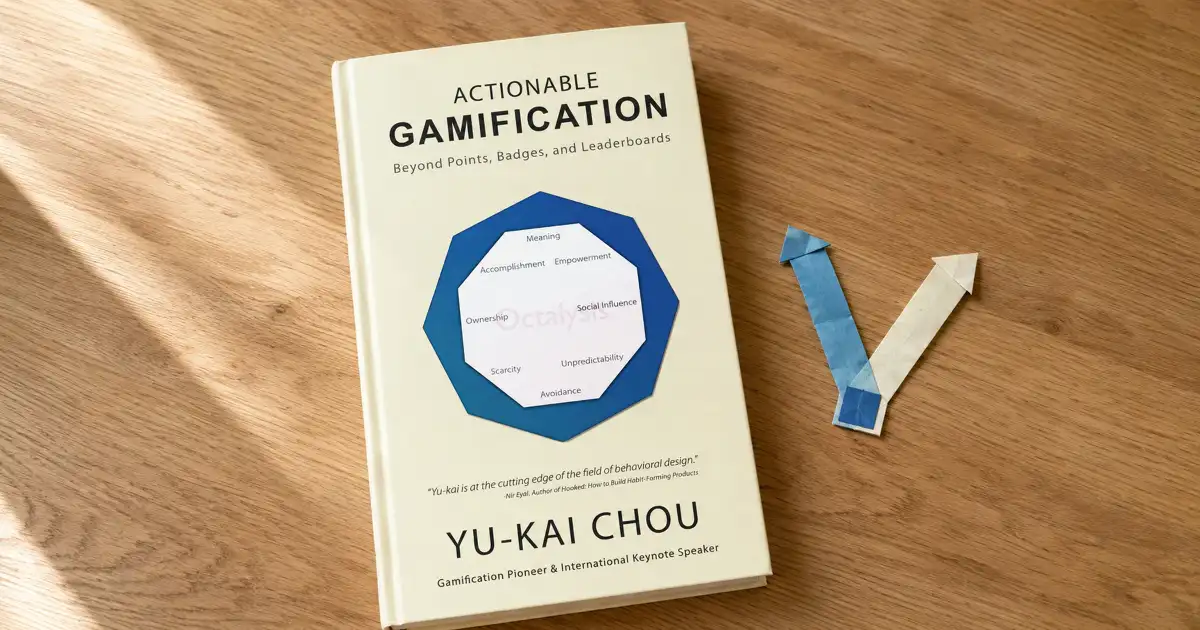
The subtitle of Yu-kai Chou’s book, Beyond Points, Badges, and Leaderboards, sets out its argument from the start. Points, badges, and leaderboards are visible mechanics that are easy to add—and easy to mistake for motivation. They may prompt an immediate response without changing the underlying experience. If learning remains a sequence of prescribed tasks, rewarding every click does not make the journey meaningful.
That criticism makes the book especially relevant to capability development. Many initiatives are designed from the supply side: content, courses, pathways, and dates. The person appears only at the end, expected to complete what someone else has organized. Chou proposes reversing the perspective and designing around the reasons people take action.
Eight drives for interpreting an experience
At the center of the book is Octalysis (opens in a new tab), a framework that organizes motivation into eight drives: meaning and calling; development and accomplishment; creativity and feedback; ownership; social influence; scarcity; unpredictability; and loss and avoidance.
Its value does not depend on claiming that all motivation fits neatly into eight boxes. It lies in broadening the diagnosis. An experience that merely communicates a goal and awards points for completion may activate achievement, but it can leave other questions unanswered: does the person understand why it matters? Can they choose how to practice? Do they receive useful feedback? Do they feel ownership of what they build? Do they have a social connection that sustains the process?
Applied to development, this changes the focus of the design.
The aim is no longer to decorate a course, but to create the conditions for someone to begin, persist, learn from each attempt, and apply what they learn with increasing autonomy.
Progress needs evidence, not just signs
The drive for development and accomplishment may seem the most obvious. Levels, progress bars, and challenges make advancement visible. But in learning, no visual device can resolve a fundamental distinction: completing an activity does not demonstrate development.
A progress indicator is legitimate when it represents an observable change: applying a practice with less support, resolving a more complex situation, sustaining quality across different contexts, or explaining a decision with stronger reasoning. When a system rewards activity and presents it as mastery, the mechanic does more than oversimplify; it can teach people to pursue the wrong signal.
In a development experience, the relevant action is rarely the consumption of content. It may be practicing, asking for feedback, reviewing an error, trying an alternative, or transferring learning to real work. Good design requires deciding which behavior should be made visible and which evidence will demonstrate progress.
Autonomy and feedback change the quality of effort
One of the framework’s most productive drives is creativity paired with feedback. Chou associates it with experiences that allow people to test combinations, observe the outcome, and adjust. This is not freedom without structure: there is a defined space of possibilities, and the system responds to the person’s decisions.
In development, this can take the form of different ways to practice the same capability, problems with more than one valid solution, or graduated challenges that allow for revision. Feedback stops being the final judgment and becomes part of the learning cycle.

This reading also exposes a common limitation of rigid pathways. An identical sequence for everyone offers administrative order but reduces ownership. Meaningful choice does not mean allowing someone to change the color of a badge.
Motivation also has an ethical dimension
Chou distinguishes between drives that tend to produce a sense of control and accomplishment, which he calls White Hat, and others that exploit urgency, uncertainty, or fear of loss, which he calls Black Hat. He does not argue that the latter should disappear, but warns that they can prompt action without well-being and must be balanced carefully. He explains the distinction in his article on White Hat and Black Hat Gamification (opens in a new tab).
In the workplace, the distinction demands an even stricter stance. A streak at risk of disappearing, a public leaderboard, or a scarce reward may increase participation while displacing the purpose of learning. These mechanics can also penalize people with less available time, turn comparison into pressure, and make asking for help feel like a loss of status.
The ethical question does not arise after the design is complete. It is embedded in the design itself: which behavior it induces, which emotion it uses, who is disadvantaged, and what happens when the reward is withdrawn.
Design the full journey
Another contribution of the book is its view of the experience over time. Chou distinguishes discovery, onboarding, scaffolding, and the endgame (opens in a new tab). People need different reasons to engage, understand how to participate, sustain their practice, and continue finding value after they have mastered the basics.
This sequence addresses a common weakness in corporate development: investing heavily in the launch and little in what follows. Initial communication can attract attention; good onboarding reduces friction. Change, however, unfolds over weeks or months of practice and then through opportunities to take on more complex challenges, contribute to others’ learning, or open new pathways.
The framework does not, by itself, provide a complete theory of learning or evidence that its eight drives form an exhaustive scientific classification. It also creates a risk that every drive will become a box to check and the design will be filled with mechanics. It is best used as a diagnostic lens, not as a prescription or a causal test.
Read this way, Actionable Gamification does not teach us to make development entertaining. It teaches us to question rewards detached from the experience and to examine the conditions that sustain action. The book’s most productive question is not which game element to add, but what kind of relationship is being designed among the person, their progress, and the purpose of learning.
Keep exploring

A career is not a ladder: how to represent real mobility paths
How can a career be represented when progress may come through specialization, projects, lateral moves, cross-functional leadership, and returns?

The Inside Gig: when mobility no longer depends on job openings
The Inside Gig proposes mobilizing talent through internal projects rather than waiting for a job opening, prompting an examination of what turns an opportunity into real work.

What evidence an internal transition needs to stop being a gamble
Deciding on an internal transition requires four pieces of evidence. They must separate transferable capability, adaptation still needed, confirmed gaps, and entry conditions.

Developing a skill does not always increase organizational capability
Even when someone develops a skill, the organization may retain the same constraint if the opportunity, support, or authority to apply it is missing.

Lateral mobility can be development without being a promotion
Even without a change in hierarchy, lateral mobility can develop judgment by changing the problems, relationships, and decisions a person faces.

How to estimate micro-progress without promising unrealistic change
Development rarely advances through clean jumps from one level to the next. Between levels, small changes in application, autonomy, consistency, or complexity deserve recognition without being converted into percentages of mastery.