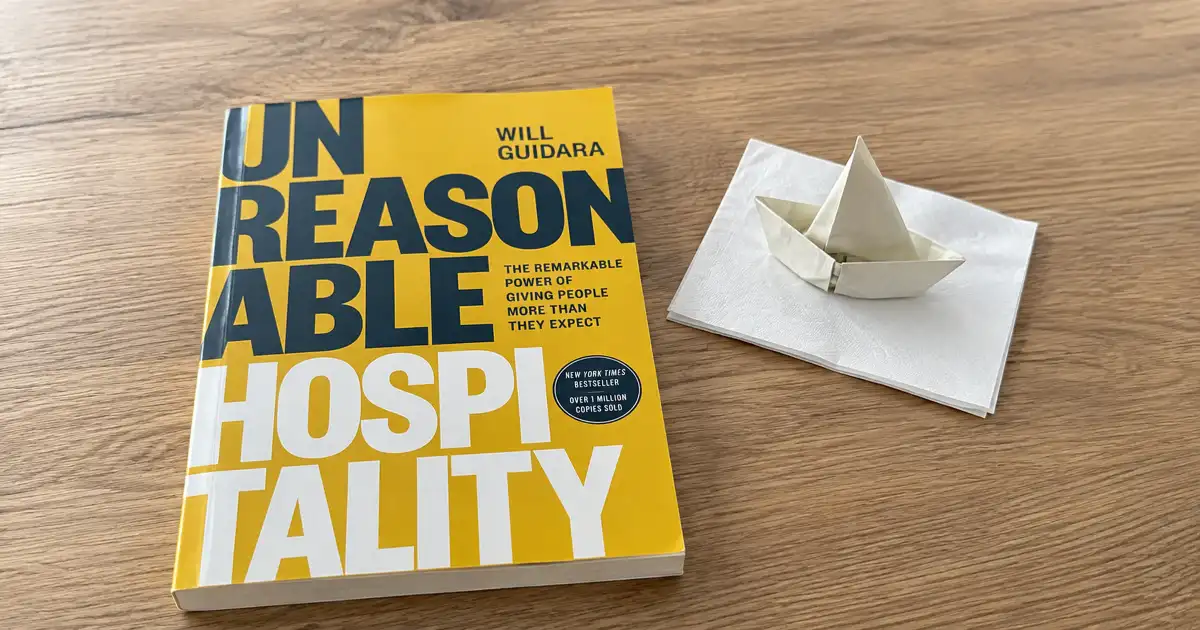
Unreasonable Hospitality and the ability to exceed expectations
Unreasonable Hospitality is often remembered for its extraordinary gestures toward guests. But the book's most useful argument lies behind those moments: exceeding expectations is not a spontaneous attitude but a collective capability built through attention, judgment, autonomy, and coordination.
The book traces Eleven Madison Park’s transformation from an ambitious restaurant into a global benchmark. Guidara organizes that journey around one idea: excellence in the product was necessary but not sufficient to create a distinctive experience. The way people felt noticed, welcomed, and cared for had to be taken just as seriously.
The best-known story involves the hot dog cart the team secured for tourists who regretted not having tried one in New York. The gesture works because it is specific, timely, and personal. Copying it would strip away precisely what made it meaningful. The book is not a collection of episodes to replicate; it depicts a system capable of noticing a signal and quickly turning it into an appropriate response for that person.
One size fits one
Guidara captures part of his approach in the phrase one size fits one. Hospitality does not mean adding the same premium touch to every experience. It requires recognizing what might matter in a particular context.
Expressed in the language of capabilities, that contextual attention takes the form of observable behaviors. Someone notices information that would normally be dismissed, distinguishes a real preference from an assumption, connects scattered details, and adapts a response without disrupting the operation. This is not an abstract quality called customer orientation. It is a combination of behaviors and decisions that can be described, practiced, and observed.
This distinction matters because personalization can become invasive or arbitrary. Seeing a person does not grant permission to accumulate data about them or interpret every signal. Sound judgment includes knowing which information is relevant, how to use it respectfully, and when an intervention would cease to be hospitable.
Autonomy needs a prepared environment
The episodes in the book convey speed: someone spots an opportunity, and the team acts. That speed can create the impression that the key is simply telling people to take initiative. Guidara describes something more demanding.
Improvisation rests on a disciplined operation. Clear roles, high standards, cross-functional communication, and a shared purpose free up attention for the exceptional. If that foundation fails, autonomy is consumed by ordinary errors. If people fear punishment for a reasonable decision, the invitation to exceed expectations remains rhetoric.
This is one of the book’s most transferable contributions. Autonomy is not the absence of limits. It is the capability to make decisions within a clear purpose, with proportionate resources and mechanisms for coordination. Guidara’s well-known 95/5 principle expresses that relationship: manage most of the operation rigorously while reserving a small margin for generous decisions that could have a disproportionate effect.
That margin should not become a license to spend or a mechanical quota. Its value lies in recognizing that absolute efficiency can eliminate any possibility of responding to context. An organization that allocates every minute, every dollar, and every decision right to predictable work leaves teams unable to address what matters when it appears.
From individual gesture to system capability
A superficial reading of Unreasonable Hospitality can reinforce the cult of the exceptional employee: the naturally empathetic person who always does more. The book’s own account argues against that interpretation. Memorable gestures depended on shared information, permission, time, preparation, and colleagues able to carry them out.
If an organization wanted to assess this capability, asking who has a positive attitude would not be enough. It would need to observe at least four relationships:

- whether people detect relevant signals without becoming intrusive;
- whether they turn those signals into decisions aligned with the purpose;
- whether they understand the scope of their autonomy and use resources judiciously;
- whether they coordinate the response so that the promise does not undermine the overall experience.
The assessment would also need to consider the context. Someone may demonstrate excellent judgment but not act because they lack authority, information, or support. Calling that person inhospitable would confuse a system limitation with an individual gap.
What the book leaves unresolved
Signal A preference or need worth addressing.
Decision A response consistent with purpose, limits and resources.
System Permissions and coordination that make it possible to sustain the gesture.
Guidara writes from the world of fine dining and from an extraordinary career. His stories offer a powerful way to understand a philosophy of service and leadership, but they do not, on their own, establish that the same model will produce identical results in every sector, at every scale, or under every working condition.
The demands implicit in exceeding expectations should not be romanticized either. A culture of generosity can deteriorate into overload if the extraordinary becomes an everyday obligation, if the cost always falls on the worker, or if the organization rewards visible sacrifice while neglecting work design.
A responsible application preserves the book’s intent while adding an organizational question: which capabilities and conditions allow an organization to offer more without asking people to exhaust themselves compensating for an inadequate system?
At that point, Unreasonable Hospitality transcends the restaurant world. Its contribution is not teaching us how to surprise people. It is showing that an exceptional experience emerges when human attention meets an operation capable of sustaining it.
Keep exploring

Leadership is not always management: how to represent cross-functional contribution
Some people change decisions, raise standards, and expand others' capability without managing a team. The architecture needs to represent that contribution without inventing informal authority.

Generalists, specialists, and hybrid roles: what the architecture should decide
Does the organization need breadth, depth, or integration? Generalist, specialist, and hybrid are possible answers, not identities the architecture should fix permanently.

How to tell whether a skills-first initiative creates value after the pilot
To decide what comes after the pilot, examine which decisions changed, which outcomes followed, and what it costs to sustain the mechanism. Participation and coverage do not yet demonstrate value.

When an expert should stop solving and start multiplying capability
Before asking an expert for more solutions, consider whether their next contribution should increase the system's autonomy. Multiplying capability changes the object of their work.

Not every critical skill is strategic: importance, scarcity, and advantage are not the same
Although importance, scarcity, and advantage are often compressed into the label “critical skill,” each dimension requires different evidence and investment. Separating them changes what must be protected, sourced, or built as a system.
What must remain common and what can vary across areas
Even when two areas work differently, they can still share an architecture. Adaptation stops being local when it changes meaning, comparability, or the rights attached to use.