Assessment & evidence

Articles about designing, interpreting, and using evidence to assess capabilities with sound judgment.

33 articles

Latest articles

  1. Three clear cylinders holding puzzle fragments; the last is frosted and conceals its contents.

    What to do when evidence is insufficient to decide

    PRYSMAP

    Missing evidence, conflicting evidence, and uncertainty are not the same problem. When they are collapsed into a generic category, an organization may manufacture certainty, defer a decision indefinitely, or treat something it has not yet observed as a gap.

  2. Wooden path diagram starting from five cards, merging, then branching toward several markers.

    What people should receive after an assessment

    PRYSMAP

    An assessment that returns only a score provides less information than it used to reach its conclusion. The person needs to understand the result, the evidence behind it, its limitations, and what they can do with it.

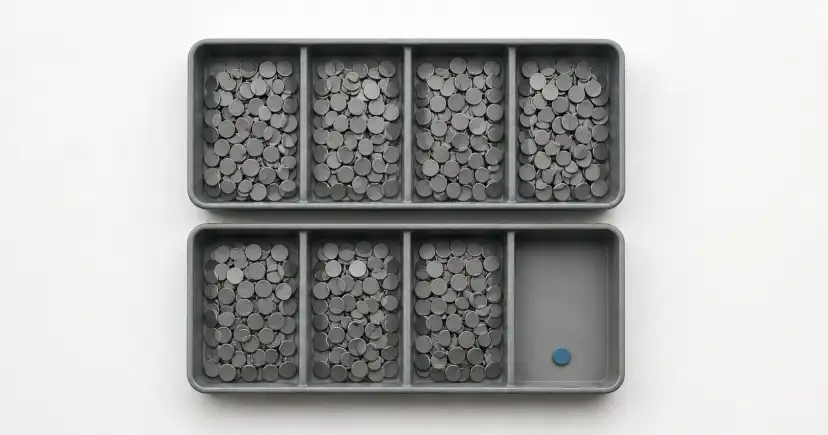
  3. Two compartment trays filled with gray discs, except for one section holding a single blue disc.

    The average can hide the most important gap

    PRYSMAP

    An average can accurately represent the center of several results while concealing the difference that matters most to the decision. Its usefulness depends on which components it combines and which of them may compensate for one another.

  4. A divided wooden tray holding cylinders and metal pieces of different sizes.

    How to design a scale that reduces differences in interpretation

    PRYSMAP

    A scale reduces differences in interpretation when it requires assessors to recognize the same evidence—not when it replaces vague words with more elegant labels. Designing one means defining what will be observed, making the boundaries between levels explicit, and testing those boundaries with cases that reveal where disagreement begins.

  5. Five different object prototypes arranged in a circle and connected to a common center by blue lines.

    Assessing a skill is not asking whether someone has it

    PRYSMAP

    A skill is a useful construct for organizing capabilities, but it never appears as a complete object to the person assessing it. What we see are partial manifestations in specific tasks, decisions, and contexts.

  6. Mechanical modules line a base, with a glowing blue line running through them.

    The five conditions of a sound skills assessment

    PRYSMAP

    A skills assessment is sound when it can support both the interpretation of its results and the decisions made from them. Five conditions must work as a chain: object, evidence, levels, sources, and rules.