
Skills-based hiring from the job posting to the decision
Removing a requirement from a job posting does not change hiring on its own. A skills-based approach must allow different career paths to supply evidence capable of changing the choice.
In 2024, research by Burning Glass Institute and Harvard Business School examined what happened after a university degree requirement was removed from a job posting. Across 11,332 occupation-company combinations, the share of new hires without a bachelor’s degree rose by about 3.5 percentage points on average. But almost all the change was concentrated in 37% of the companies studied. In the others, the hiring profile barely changed or the initial opening was not sustained. The difference between postings and hires was important; so was the difference between companies. Sigelman, Fuller and Martin, 2024 (opens in a new tab).
The study linked postings to workers’ career histories in the United States, comparing periods before and after the change as well as similar roles. This is observational evidence, not an experiment isolating the effect of deleting a phrase. Nor do its magnitudes automatically describe our labor markets.
The easiest reading would be that companies promise an opening they do not deliver. That possibility deserves examination, but leaves the problem incomplete. A revised posting tells us about a stated requirement; a hire shows that someone got in. Between the two are people deciding whether to apply, screening criteria, assessments, selectors’ preferences and offers that may be rejected. The final result allows us to ask what changed, but does not identify on its own where opportunity opened or closed.
The Skillability Index, published by Burning Glass Institute in January 2026, introduces a nuance that changes that reading. It separates postings, hiring and progression, with comparisons relative to roles and industries. Among its patterns are the Quiet Reformers: companies with relatively high hiring of people without that degree, even though their postings retain academic requirements. The discrepancy works in the opposite direction too. The index also distinguishes hiring from offering promotion or internal mobility opportunities: a company can stand out in the former and lag in the latter. Woodyard and colleagues, 2026 (opens in a new tab).
Both reports belong to the same line of research, using US postings and career histories; they are not two independent replications. The second broadens the diagnosis. Its scores are relative positions, not hiring percentages or direct tests of proficiency in a skill.
What we are willing to recognize when choosing
The scope of these indicators needs to remain clear. Hiring more people without a degree allows one dimension of access to be observed; it does not prove that they were selected for their skills, that the assessment is valid or that subsequent work is better. Nor does hiring someone with a degree contradict a capability-based approach. Confusing these things would replace a preference for credentials with another biographical preference, without necessarily improving the decision.
The alternative does not require declaring education irrelevant. The OECD report on skills-first labor markets, published in June 2026 (opens in a new tab), proposes complementing qualifications and job titles with more specific information about capabilities. The question is what a credential demonstrates for the work under consideration and what other evidence can support a comparable conclusion. This does not authorize dispensing with a required license or turning any brief test into a sufficient substitute for education.

If we admit different career paths, we need to be able to interpret what they bring. Experience acquired in a small company may not be described using familiar job titles; a move between sectors may hide relevant work beneath different vocabulary. These are possibilities to examine, not guarantees of equivalence. Adding skills to a form achieves little if, when a less familiar candidate appears, we revert to requiring the usual career path as the only acceptable way to demonstrate them. The point is not to grant capability because a degree is absent, but to avoid denying it without examination.
That changes the question we would use to review a hiring process. We need to know who came to be considered, where candidates were ruled out and what reasons supported the choice, along with who ultimately accepted. If the result remains similar, there may be a well-founded decision or a persistent barrier: the aggregate figure does not allow us to choose the most convenient explanation. And after hiring, we will have to examine whether the opening also reaches broader responsibilities, without demanding that every hire immediately produce a promotion.
Opening a hiring process on the basis of skills commits us to considering that the best evidence may come from a career path we would not have chosen in advance. It does not require hiring someone different to demonstrate openness. It requires something harder: allowing their capability to make us change candidates, rather than asking them, again and again, to change their biography.
Keep exploring

What evidence an internal transition needs to stop being a gamble
Deciding on an internal transition requires four pieces of evidence. They must separate transferable capability, adaptation still needed, confirmed gaps, and entry conditions.

How to adapt an assessment without changing what it is meant to measure
Two people may demonstrate a capability in different ways while still meeting the same core demand. Fair adaptation requires separating the construct from barriers created by the format.

Assessing the work people already do with AI
Assessing AI-assisted work requires observing decisions, not just deliverables. The assessment must justify which assistance it retains and which responsibility the evidence supports assigning.

The path to making decisions with autonomy
Onboarding progresses when someone can take responsibility for decisions with judgment, resources and authority. Seeking advice can be part of that autonomy, not its negation.
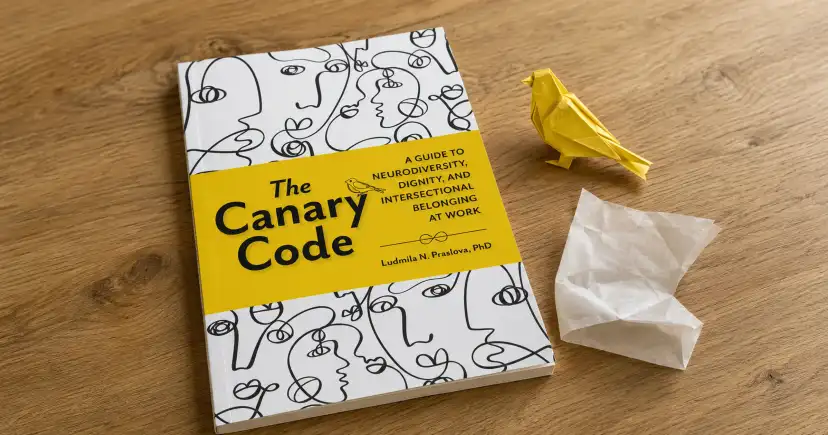
The Canary Code: when systems mistake difference for deficit
Ludmila N. Praslova’s The Canary Code uses neurodivergent experience as a signal about work systems. Its metaphor changes where diagnosis begins.

Bias and fairness: the same scale does not guarantee the same opportunity to demonstrate
An uncomfortable finding in assessment is that a common scale does not produce fairness when people lack comparable opportunities to generate and present evidence.